Two furry characters can share the same species, the same colors, and the same pose — and one of them will feel like a person while the other feels like a costume. The difference is not the design. It is the life behind it. A character with a past makes choices the viewer can predict, keeps promises the viewer can remember, and survives a bad render because the story carries them. This guide is about furry backstories: how to give your character a life beyond the design, in a way that shows up in the images themselves.
El primer artículo de este sitio explicaba cómo diseñar un personaje furry que se sienta como una persona, no una lista de partes. El segundo explicaba cómo elegir la especie adecuada. El tercero explicaba caras y expresiones. The fourth explained the body details. This one is the layer underneath all four: the life that explains why the character looks the way they do — the design is the surface, and the backstory is the character.
Veredicto rápido
Write one page of backstory before you generate one image: where they grew up, what they lost, what they want, and the one secret they would never tell. Then let every prompt choice answer to that page. A backstory you never write is a backstory you cannot use, and the backstory is the character.
En esta guía
- 1. Start with the wound, not the species
- 2. Three beats that explain the present
- 3. The one place that made them
- 4. People they lost, people they keep
- 5. The secret they would never tell
- 6. Backstory that shows in the image
- 7. The 20-line lore sheet
- 8. When backstory becomes baggage
- Costo: backstory is free, los re-roll no son
- 9. Consentimiento: la regla que lo decide todo
- Preguntas frecuentes
Backstory vs design, lado a lado
| Design only | Design + backstory | |
|---|---|---|
| First impression | Pretty animal | A person you can place |
| Second image | A new guess | The same character, older |
| Expresión | Whatever the prompt says | Whatever the past demands |
| When a render fails | Start over | Adjust and keep going |
The table is the whole argument in one place. Design answers what the character looks like; backstory answers why — and the backstory is the character. The rest of this guide is how to write the why so that it shows up in every image.
1. Start with the wound, not the species
Every backstory worth writing starts with a wound: the one thing that happened to the character and never fully healed. Not a tragedy for its own sake — a specific, small, named event. A fox who was the smallest in a litter of six and learned to be fast because being slow meant going hungry. A wolf who was raised by a grandmother who taught them to track, and who now tracks everything — people, rumors, exits. The wound is the engine; everything else in the story is fuel for it.
Why start here and not with the species? Because the species is a costume and the wound is a decision-maker. A character who is a fox because they grew up on the forest edge, learned to be quiet, and now hates being watched will make specific choices: the pose is guarded, the eyes check the door, the tail stays low. The species explains the ears; the wound explains the posture. And the backstory is the character — the wound is where the character starts.
Keep the wound to one sentence. “Grew up the smallest in the litter, learned to be fast” is a backstory. “Had a difficult childhood and now has trust issues and a dark past and a mysterious scar” is a pile of adjectives. One wound, one sentence, and everything else in the lore sheet must answer to it.
2. Three beats that explain the present
After the wound, write three beats: three moments in the character’s life that explain how they are now. The first beat is the wound itself. The second is the choice they made because of it — the fox who learned to be fast became a scout; the wolf who learned to track became the one who finds lost things. The third is the cost of that choice: the scout is never still, the tracker never trusts a closed door. Three beats, and the present tense of the character is explained.
Three is a deliberate limit. One beat is a fact, not a story. Five beats is a novel, and nobody reads a novel to write a prompt. Cuando escribes el prompt, you do not paste the beats in — you let them choose the pose, the setting, and the expression. The backstory is the character, and the beats are the proof.

3. The one place that made them
Every character has one place that made them: the forest edge, the spaceport dock, the cyber club basement, the grandmother’s kitchen. Pick one and make it specific. Not “a forest” — a forest edge where the trees thin out and the town lights show through. Not “a city” — the third-floor apartment above the bakery, where the smell of bread woke them every morning. A place is only useful when it is small enough to picture.
The place does two jobs in the images. First, it gives you a setting that is not generic: the forest edge is a background you can reuse, and a reused background is a consistent world. Second, it explains the character’s habits: a character from the forest edge knows how to be quiet; a character from the spaceport dock knows how to haggle; a character from the bakery apartment knows how to get up early. The place is the wound’s address, and the backstory is the character.
4. People they lost, people they keep
A character with no people is a character with no stakes. Write down two names: one person they lost, and one person they keep. The lost person explains the wound’s cost — the grandmother who taught them to track and is now gone, the pack that scattered, the sibling who stayed behind. The kept person explains what they still protect — the younger sibling they send money to, the friend who knows the secret, the rival who keeps them honest.
These two names do more work than any paragraph of personality traits. “Curious, loyal, cautious but kind” is a list; “she tracks lost things because she lost her grandmother, and she protects her younger brother” is a person. The backstory is the character, and the people are the backstory.
Keep the names short and the relationships simple. One lost, one kept. If the lore sheet has six names, it has no names — it has a census.
5. The secret they would never tell
Every character needs one secret: something they would never tell, that the viewer can almost see. The scout who is afraid of fire. The tracker who cannot read a map. The fox who is terrible at being quiet and hates that about themselves. A secret is not a plot twist — it is a crack in the armor, and the crack is what makes the character feel real.
The secret works in images because it gives you a specific detail to show: the scout stands a little too far from the campfire; the tracker holds the map upside down when nobody is looking; the fox’s ears flatten when someone mentions the fire. One detail, shown once, and the viewer knows there is more to this character than the design. The secret is the cheapest depth you can buy, and the backstory is the character.
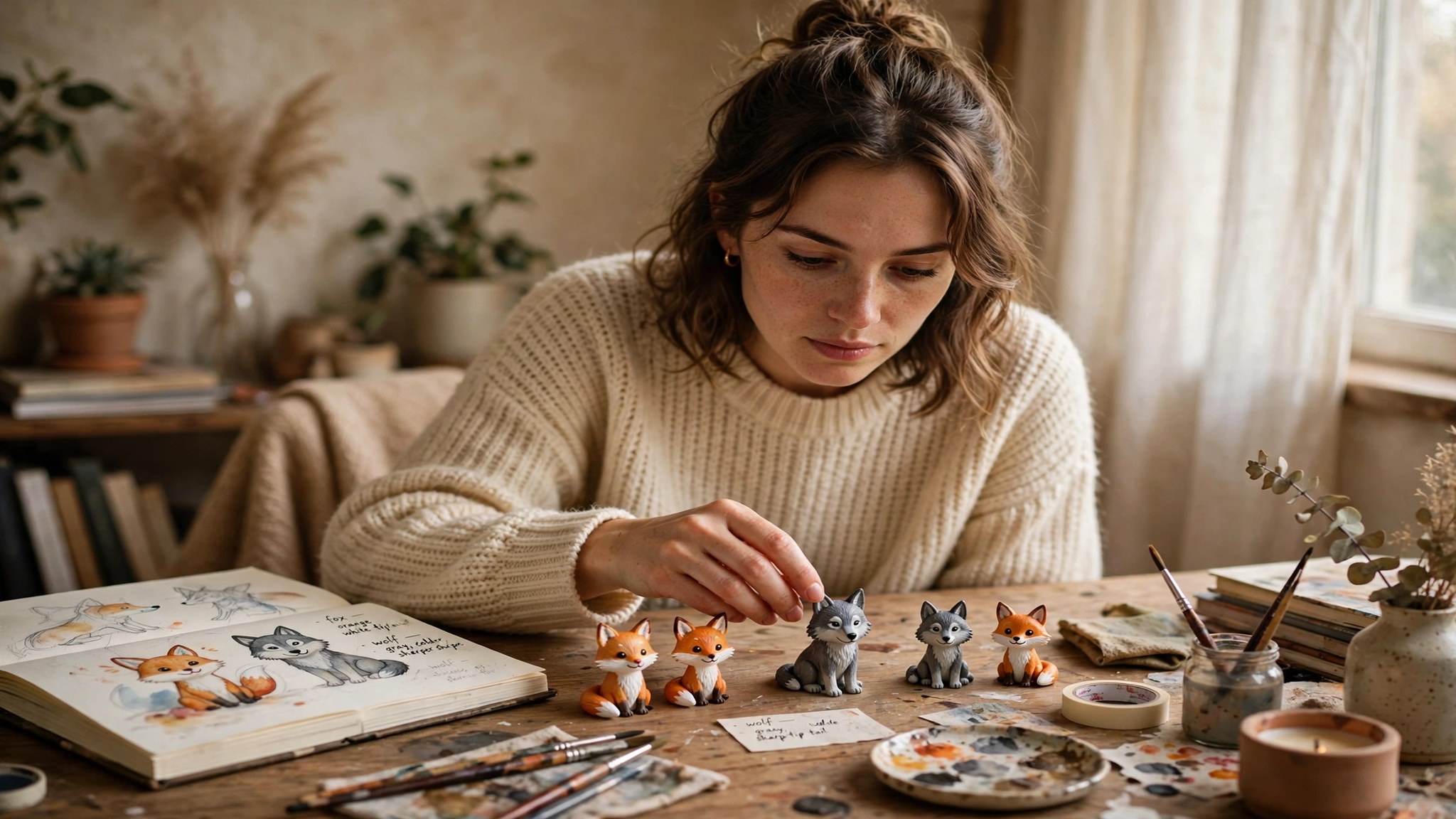
Do not write the secret into the prompt as a sentence. Write it into the pose. A secret told is a spoiler; a secret shown is a character.
6. Backstory that shows in the image
A backstory that never shows in an image is a diary, not a tool. The test is simple: for each line of the lore sheet, ask what it changes in the picture. The wound changes the posture. The place changes the background. The lost person changes the expression — a little sadness at the edge of a smile. The kept person changes the prop — a letter, a charm, a photograph held in a paw. The secret changes one detail — the distance from the fire, the upside-down map, the flattened ear.
If a line changes nothing in the picture, cut it or rewrite it until it does. “She is brave” changes nothing. “She stands between the viewer and the door” changes everything. The prompt is where the backstory earns its keep: not as text pasted into the prompt box, but as choices — pose, escenario, prop, expression — that the backstory made for you before you typed a word. The backstory is the character, and the image is where you prove it.
7. The 20-line lore sheet
Here is the whole backstory, on one page, in twenty lines. Copy this template and fill it in for your character:
Name — Species — Age — Home place — Wound (one sentence) — Beat one — Beat two — Beat three — Lost person — Kept person — Secret — Want (what they are trying to get) — Fear (what they are trying to avoid) — Habit (one thing they always do) — Tell (one thing that gives them away) — Favorite place — Favorite food — One possession — One line they would say — One line they would never say.
Twenty lines, and the sheet is done. Anything longer is a novel; anything shorter is a mood board. Fill it in once, keep it beside the prompt box, and use it for every image in the set. The sheet is the character’s memory, and a character with a memory is a character who stays the same from the first image to the tenth. The backstory is the character, and the sheet is the backstory you can hold.
8. When backstory becomes baggage
Backstory becomes baggage when it starts deciding things the image does not need. The warning signs are easy to spot: the lore sheet is three pages, the prompt is a paragraph of biography, and every image looks like an illustration of a novel instead of a scene. A backstory should fit in the prompt box’s margin, not in the prompt box itself.
The fix is the same as the fix for over-designed characters: cut to the wound, the three beats, and the secret, and let the rest go. A backstory that is too long is a backstory that is not being used — it is being admired. And a backstory that is admired instead of used is baggage. The backstory is the character, but the character is the one in the image, not the one in the notebook.
Costo: backstory is free, los re-roll no son
Writing a lore sheet costs nothing — no credits, no generation, no waiting. Una imagen es 6 créditos — aproximadamente $0.12 en el $19.99 manada y $0.07 en el $59.99 manada. Diez imágenes de prueba son 60 créditos — aproximadamente $1.20 en el $19.99 manada y $0.72 en el $59.99 manada. Una edición de imagen a imagen es 49 créditos — aproximadamente $0.98 en el $19.99 manada y $0.59 en el $59.99 manada. Precios verificados 13 nov. 2026; el generador muestra el coste exacto antes de ejecutarlo, así el precio nunca es una sorpresa.
That is why the lore sheet saves money: a character whose backstory is written before the first image needs fewer re-rolls, because the pose, the setting, and the expression are already decided. Write first, generate second, and the generating is the saving.
La base gratuita sigue en pie: gratis, sin registro. Empezar gratis, and the starting is the writing.
9. Consentimiento: la regla que lo decide todo
Genera solo imágenes y vídeos de ti mismo, o de adultos ficticios. Nunca generes una imagen o un vídeo de una persona real sin su consentimiento — ni siquiera de una celebridad, no un conocido, no un desconocido. La generación no consensuada no está permitida, y una imagen generada es más difícil de retirar que una foto una vez compartida. La herramienta está hecha para tus propias imágenes y adultos ficticios, y ese límite es absoluto.
This matters twice over for furry characters: a furry character is a fictional adult, and the person behind the character — you — is the one who consents to your own image. Build the character from your own photos and your own imagination, and keep real people out of it.
Preguntas frecuentes
How long should a furry backstory be?
Una página: a wound, three beats, un lugar, one lost person, one kept person, and one secret. Anything longer is a novel; the twenty-line lore sheet in this guide is the whole template.
Do I put the backstory in the prompt?
No. You let the backstory choose the pose, the setting, the prop, and the expression, and you write those choices into the prompt. A backstory pasted into the prompt box is a spoiler; a backstory shown in the image is a character.
What if my character has no wound?
Then they have no engine. Give them one small, specific, named event — the smallest in the litter, the grandmother who taught them to track — and let everything else answer to it.
Can one backstory cover a whole cast?
Sí, and it should. The kept person in one character’s lore sheet is the next character you design, and the lost person is the ghost that haunts the set. A cast grows out of a lore sheet, not out of a species list.
How do I know the backstory is working?
Can you explain the character’s expression in one sentence that uses a beat? “She is smiling because the scout finally found the lost pack” is a backstory doing its job. If you cannot, the backstory is a diary, not a tool.
¿Puedo hacer porno con IA de una persona real??
No. Genera solo imágenes de ti mismo, o de adultos ficticios. No está permitido generar una imagen de una persona real sin su consentimiento.
Veredicto final
Write one page of backstory before you generate one image: the wound, three beats, un lugar, two people, and one secret. The design is the surface, and the backstory is the character.