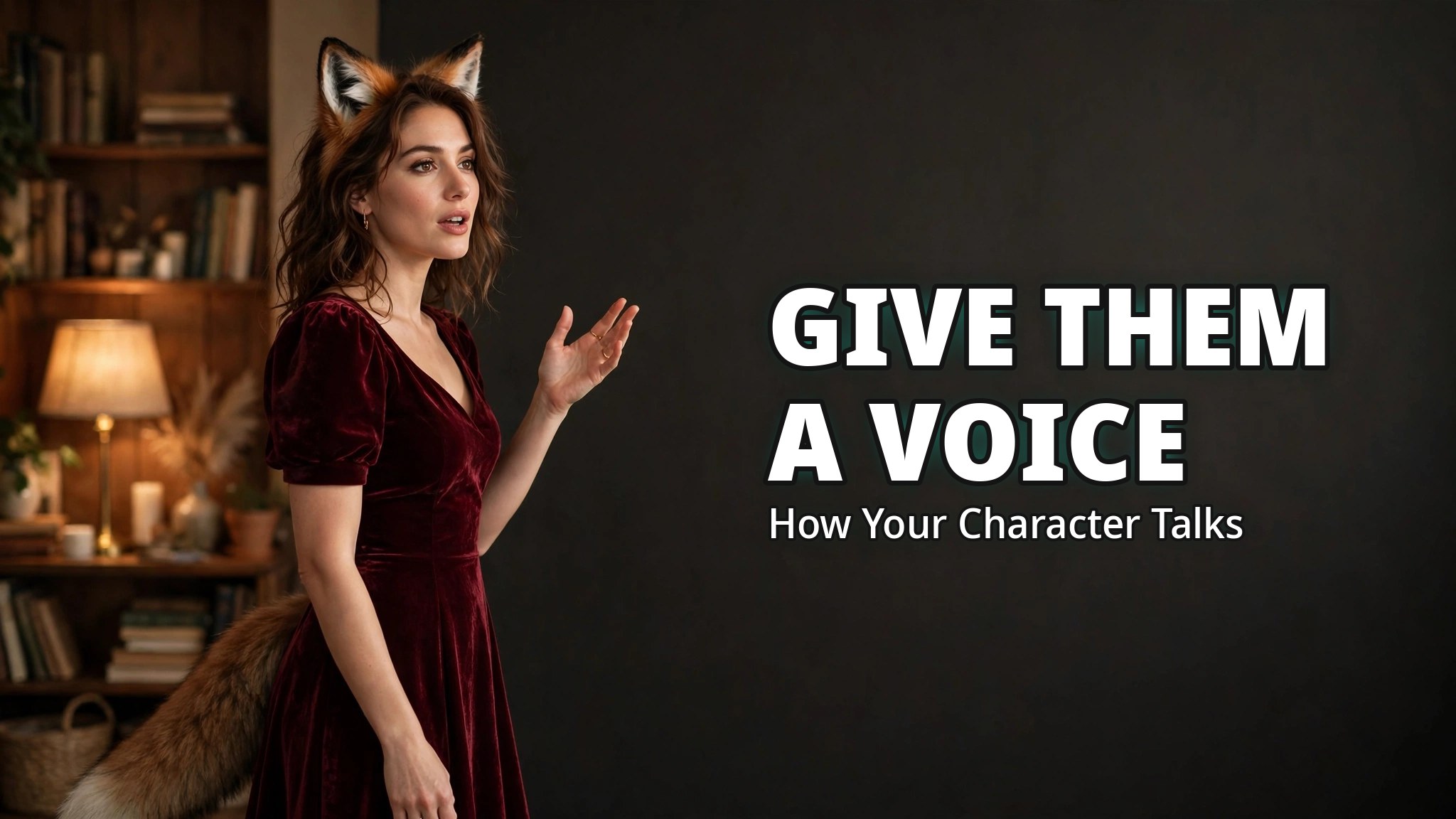
A furry character can have the right ears, the right tail, the right room, and still feel like a stranger. The missing piece is usually the voice. When a character opens her mouth and sounds like nobody in particular, the whole design flattens into a costume. When she talks in a way that only she would talk, the ears stop being decoration and start being part of a person.
Voice is the cheapest part of a character to build and the easiest to skip. It needs no generation credits and no new tools. It needs a few decisions, written down, and then kept. This guide shows how to give your furry character a voice that survives from one scene to the next: what she says, what she never says, how fast she talks, and how the animal in her changes the words without turning her into a catchphrase.
Kiire hinnang
Write the voice before you write the scene. Pick five traits — vocabulary, rhythm, bluntness, humour, and silence — and give each one a short answer. If a line could belong to any of your characters, it belongs to none of them. A voice that is consistent across five scenes is worth more than a clever line in one.
see juhend
- 1. Voice is the third layer of the character
- 2. Five dimensions that make a voice
- 3. Let the species shape the speech, not replace it
- 4. Dialogue that does work, not decoration
- 5. The five-line test: can you tell them apart blind?
- 6. A voice sheet that keeps her steady across scenes
- 7. How much dialogue belongs in a generation brief
- 8. Three worked voices: Rebane, wolf, and cat
- Hind: Üks tegelane, one voice, one bill
- 9. Nõusolek: reegel see otsustab kõik
- KKK
A voice that sounds like a person vs a voice that sounds like a label
| A voice that sounds like a person | A voice that sounds like a label | |
|---|---|---|
| Word choice | Specific words she would actually use, repeated across scenes | Generic words any character could say |
| Rhythm | Short bursts when she is excited, long sentences when she is thinking | Every line the same length, the same shape |
| Bluntness | She dodges, or she hits the point — and does it the same way every time | She is blunt in one scene and evasive in the next, for no reason |
| Humour | One kind of joke, used sparingly | A different joke style in every scene |
| Silence | She goes quiet at a predictable moment, and the quiet means something | She never stops talking, so nothing she says lands |
| Liik | The animal colours the voice — a fox hedges, a wolf cuts to the point | The animal is a sound effect pasted on the end of a sentence |
1. Voice is the third layer of the character
Character design usually happens in two layers. The first is the body: kõrvad, saba, fur pattern, posture. The second is the home: the room she lives in, the objects she owns, the light she sits in. Both layers are visible, and both are easy to describe in a prompt. The third layer is invisible, and it is the one audiences remember longest: the way she talks.
A voice does three jobs that the body and the room cannot do. It shows how she thinks, because word choice is thinking made audible. It shows how she relates to other people, because the way she addresses someone is the relationship. And it shows change over time, because a voice that shifts slightly across a story tells the audience that something happened to her. Start with one question, answered in a single sentence: what does she sound like to someone who has just met her? “She talks like someone who has already decided and is waiting for you to catch up.” That is a voice. “She is funny and kind” is not a voice. It is a wish list.
2. Five dimensions that make a voice
Break the voice into five dimensions and give each one a short, specific answer: vocabulary, rhythm, bluntness, humour, and silence. Five is enough to make a voice recognisable and few enough to remember while you write.
Vocabulary is the words she reaches for first. Write down ten words she uses a lot and ten words she would never use. The second list is more useful than the first. Rhythm is the shape of her sentences: short bursts, or long careful sentences that take the scenic route to the point. Decide her default rhythm first, then decide what breaks it — when she is normally terse and suddenly talks for a minute without stopping, something has gone wrong for her, and the reader knows it before she says so. Bluntness is how directly she says what she means: direct, evasive, or direct about small things and evasive about big ones. Humour is the kind of joke she makes, not whether she is funny — pick one kind and keep it. Silence is what makes her go quiet, and what she does instead of talking. A character with a predictable silence is a character the audience can read.

3. Let the species shape the speech, not replace it
The animal in a furry character should colour the voice, not replace it. A fox does not need to say clever things. A wolf does not need to growl every line. When the species becomes a sound effect pasted on the end of a sentence, the character gets smaller, not bigger. The animal works best as a tendency: the way she approaches a problem, the thing she notices first, the habit she cannot quite hide.
4. Dialogue that does work, not decoration
Dialogue in a scene should do at least one of three jobs: reveal something about the speaker, change the relationship between two people, or move the situation forward. A line that does none of the three is decoration, and decoration is the first thing to cut when a scene feels long. Subtext is the tool that makes dialogue feel real. People rarely say what they mean in plain words. Write the plain meaning first, then write the line she would actually say, and keep both in your notes. The gap between them is the subtext, and the gap is where the character lives.
5. The five-line test: can you tell them apart blind?
Here is the test that decides whether a voice works. Write five lines, one from each of your characters, on the same topic: the rain, a late train, a door that will not open. Remove the names. Show the five lines to yourself a day later. If you can match each line to its character without hesitation, the voices are distinct. If you cannot, the voices are not finished, however much you like the individual lines.
6. A voice sheet that keeps her steady across scenes
A voice sheet is a one-page document that holds the voice still while the story moves. It is not a biography. It is a working tool: five dimensions, the test lines, the ten words she uses and the ten she never uses, the thing that makes her go quiet, and one paragraph of her talking about something ordinary, like making breakfast or waiting for a bus.
7. How much dialogue belongs in a generation brief
Image and video generators do not need dialogue, and a brief stuffed with lines of speech usually makes the image worse. The generator cannot hear the voice. It can only see the scene. So translate the voice into three visible things. First, posture: a blunt character stands square and looks at the camera; an evasive one is caught mid-turn, looking away. Second, distance: a warm character is close to the other person in the frame; a guarded one has space between them. Third, hands: talkers gesture, quiet people hold something, and the object they hold tells you what they are not saying.
8. Three worked voices: Rebane, wolf, and cat
A fox who hedges. Her vocabulary is careful: “probably,” “maybe,” “it depends.” Her rhythm is long sentences with a soft landing, and she is direct about small things and evasive about big ones. Her humour is dry and aimed at herself. Her silence comes when someone asks her what she wants. She goes quiet, pours the tea, and changes the subject. Her line about the rain: “It will probably stop by morning, but I would not plan around it.” You can hear the exit in the sentence.
A wolf who is gentle. Her vocabulary is plain and her sentences are short. She names the problem first and the reason second. Her humour is warm and rare, and it lands harder because she does not use it often. Her silence comes when she is angry: she stops talking entirely, and everyone in the room notices. Her line about the rain: “It is raining. We wait, or we go. Pick one.” The gentleness is in the “we,” not in the softening, because there is no softening. That is the point.
A cat who is terse. Her vocabulary is small and precise. She says half the sentence and expects you to keep up. Her rhythm is short bursts with long pauses, and the pauses are where she does her thinking. Her silence is her default state, and she talks only when talking is cheaper than silence. Her line about the rain: “It is raining. So?” Three words, and the whole scene has to answer her. None of these voices is a rule about foxes, wolves, or cats. They are three worked examples of the same method: five dimensions, one hard choice in each, and a line that only fits one of them.
Hind: Üks tegelane, one voice, one bill
Voice work itself costs nothing in credits: the decisions, the sheet, and the test lines are written by you, not generated. The cost comes when the voice reaches the image. Hinnad kontrollitud 13 nov. 2026. Pack prices for reference: $19.99 Jaoks 1,000 credits and $59.99 Jaoks 5,000 krediidid, both one-off payments with credits added immediately; annual packs are $119.88 Ja $359.88, paid once and issued monthly over twelve months, and at the $19.99 pack a credit works out at about $0.020, and at the $59.99 pack about $0.012. A standard image at the $19.99 pack costs about $0.12, and at the $59.99 pack about $0.07.
Five test images of one character, one per scene, at the standard image rate of 6 credits each, is 30 krediidid — meist $0.60 at the $19.99 pakett, meist $0.36 at the $59.99 pakett. A face swap costs 26 credits per swap. A 5-second video template costs 351 krediidid, meist $7.02 at the $19.99 pack and about $4.21 at the $59.99 pakett, which is why voice testing belongs in stills first and video second. The free tier on this site is free, Registreerimist pole, so the first voice test costs nothing at all.
9. Nõusolek: reegel see otsustab kõik
Every character in this guide is fictional, and every image is generated from your own prompts. That is the boundary, and it does not move. Generate only characters you created yourself or fictional characters with no real person behind them, and only adults. Never generate a real person, never generate a likeness of someone you know, and never use a photo of a real person as the starting point for a character without that person’s clear consent. Label fictional characters as fictional when you share them, and do not present a generated character as a real person in a chat, a profile, or a message. If a real person could be confused with your character, you have built the wrong thing, and the fix is to change the character, not the label.
KKK
How do I start giving my furry character a voice?
Answer the five dimensions in one line each: vocabulary, rhythm, bluntness, humour, and silence. Then write the rain line — what she says about the rain in her own words. If the line could belong to any of your characters, the dimensions need sharper answers.
Should the species decide how my character talks?
Let the species colour the voice, not replace it. Use the animal as a tendency — a fox hedges, a wolf is direct, a cat is terse — and then push against it. A wolf who is gentle is more interesting than a wolf who is fierce.
How do I know if two of my characters sound too alike?
Run the five-line test: one line per character on the same topic, names removed, read a day later. If you cannot match each line to its character without hesitation, change one dimension hard.
How much dialogue should I put in an image prompt?
None. Generators cannot hear a voice. Translate the voice into visible choices instead: posture, distance between characters, and what the hands are doing. Keep one line in your notes for the caption, written in her voice.
What is a voice sheet, and do I really need one?
A voice sheet is a one-page record of the five dimensions, the words she uses and never uses, what makes her go quiet, and one ordinary paragraph in her voice. You need it the moment you have more than one scene.
Can a character’s voice change over time?
Jah, but change it by decision, not by accident. When she stops hedging or starts joking with someone new, write down why and when it happened. A voice that drifts without a reason is a character coming apart.
Loe edasi
If the voice is the third layer, the first two are worth revisiting: Where They Live: Designing a Home That Fits Your Furry Character covers the room, Ja Two Species, One Scene shows what happens when two voices share a frame. For the body in motion, Moving Like an Animal covers poses and body language. The character tools are on the Tehisintellekti pornogeneraator page, and video scenes start at the Tehisintellekti pornovideogeneraator.