A single-species scene is a solo. A mixed-species scene is a duet, and a duet only works when the two voices are different enough to hear apart and close enough to harmonise. Put a fox and a wolf in one frame and the audience should read two animals, two bodies, two ways of moving — and one scene that holds them together.
Most mixed-species images fail in one of two ways. Either the two characters look like the same person with different ears glued on, or they look like two separate portraits pasted into one frame. This guide fixes both: how to give each species its own body language, how to stage the pair so the frame reads as one scene, and how to keep the result believable when the two characters share the same room, the same light, and the same story.
クイック評価
Give each species one body rule and one tell, and never let them share both. A fox crouches low and listens with one ear; a wolf stands tall and watches with both ears forward. Stage the pair at different heights, in different silhouettes, touching the same object or looking at the same thing, and the frame reads as one scene instead of two portraits. When two species in one frame share a light, a floor, and a reason to be together, the audience stops checking the ears and starts reading the relationship.
このガイドでは
- 1. One frame, two rulebooks
- 2. Size, silhouette, and who stands where
- 3. Shared traits, separate tells
- 4. The interaction that proves the pairing
- 5. Light and colour: one scene, one grade
- 6. Three pairings that work
- 7. The mixed-species checklist before you generate
- 費用: two characters, one bill
- 8. 同意: すべてを決めるルール
- よくある質問
Two portraits pasted together vs one scene with two species
| Two portraits pasted together | One scene with two species | |
|---|---|---|
| Body language | Both characters stand the same way | Each species moves by its own rule |
| Height | Same height, same stance | Deliberate difference, staged on purpose |
| 目 | Both look at the camera | At least one looks at the other, or both look at the same thing |
| Contact | No shared object, no touch | A book, a cup, a hand — something shared |
| Light | Two different light directions | One light, one shadow direction, one grade |
| Reading | Two characters who happen to share a frame | Two characters who belong in the same story |
The table is the whole test. If you cover one character with your hand, the other should still look like a complete scene — and if you cover the other, the first should too. But the scene is only finished when both are visible and the eye can travel between them without hitting a seam: same floor, 同じ光, same reason to be there.
1. One frame, two rulebooks
Start by writing one rulebook per species, in one sentence each, before you write anything about the scene. A fox: 低い, quick, ears always working. A wolf: tall, forward-weighted, ears fixed on the thing that matters. A cat: arched, turning ears before the body. A rabbit: still, then suddenly gone. If you cannot state the rule in one sentence, you do not have a species yet — you have a costume.
The rulebook is what stops the two characters from collapsing into the same person. Give the fox the crouch and the wolf the upright stance, and the audience reads two animals even before they notice the ears. Give both the same upright stance and the audience reads one person twice, with different accessories. The ears are the label; the body is the proof.
2. Size, silhouette, and who stands where
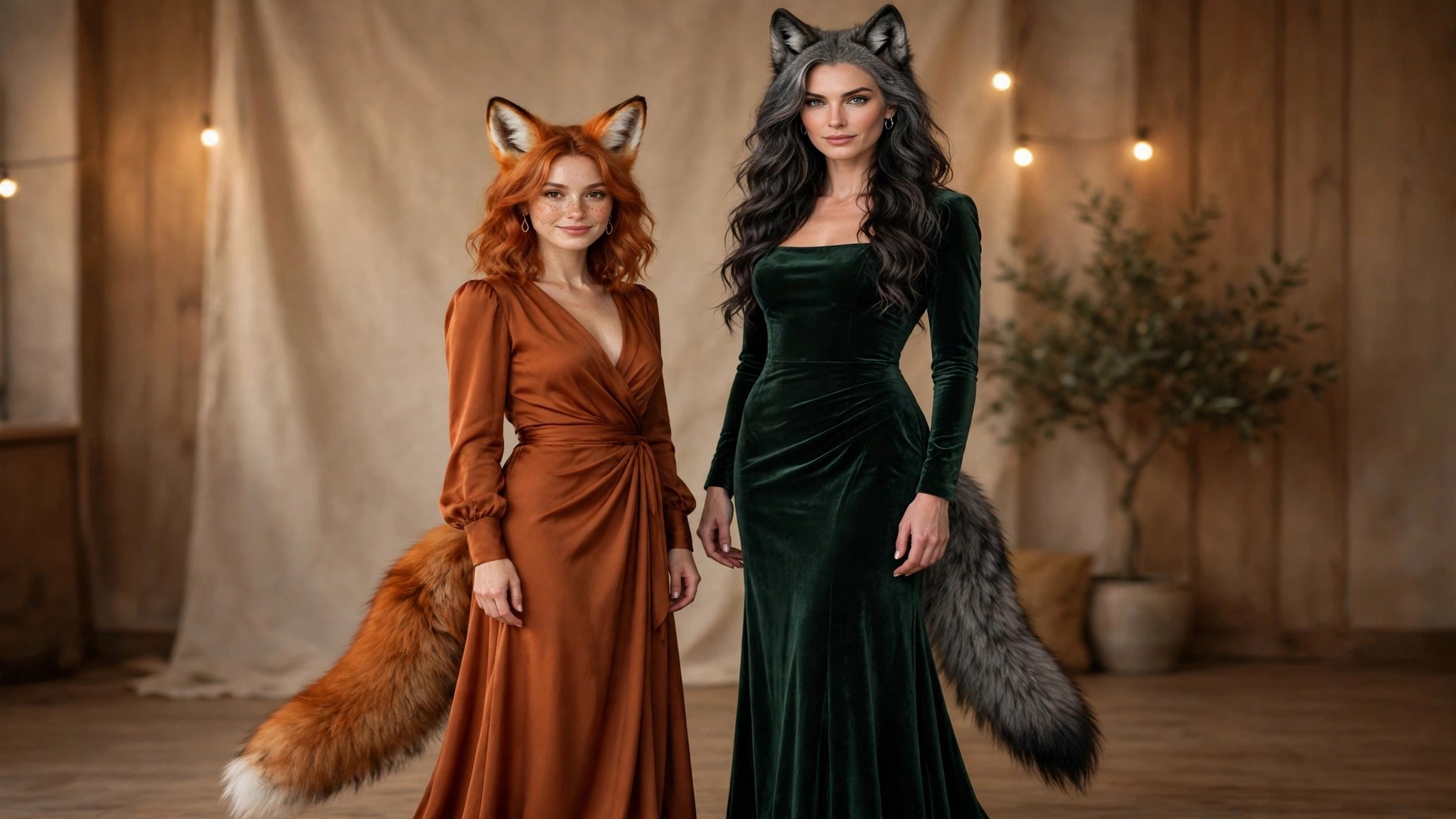
Two characters at the same height, in the same stance, in the same clothes, read as twins. The fastest fix is the cheapest: make one taller. A wolf should stand a head taller than a fox, not because every wolf is taller than every fox, but because the height difference is the first thing the eye reads, and it reads it before the ears. Put the taller character slightly behind and the shorter one slightly forward, and the frame gains depth for free.
Silhouette is the second fix. If both characters wear the same long dress, their outlines merge into one shape. Give one a long skirt and the other a fitted jacket, or one a loose robe and the other a sharp-shouldered coat. The tails help here too: a fox tail is long, 低い, and sweeping; a wolf tail is shorter, higher, and straighter. When the two tails point in different directions, the frame feels alive. When they hang the same way, the frame feels copied.
3. Shared traits, separate tells
Every mixed-species pair needs one shared trait and two separate tells. The shared trait is what makes them a pair: the same warm light on both faces, the same style of dress, the same room. The separate tells are what makes them two species: the fox’s ear turned sideways while the wolf’s ears both face forward; the fox’s tail curled around her feet while the wolf’s tail stands straight out behind her.
The mistake is to share the tells and separate the traits. If both characters have one ear forward and one ear back, the ears stop meaning anything. If one character is lit warm and the other is lit cold, the pair stops looking like a pair. Keep the light, the room, and the wardrobe shared. Keep the ears, 尾, and the posture separate. That is the whole recipe: shared world, separate bodies.
4. The interaction that proves the pairing
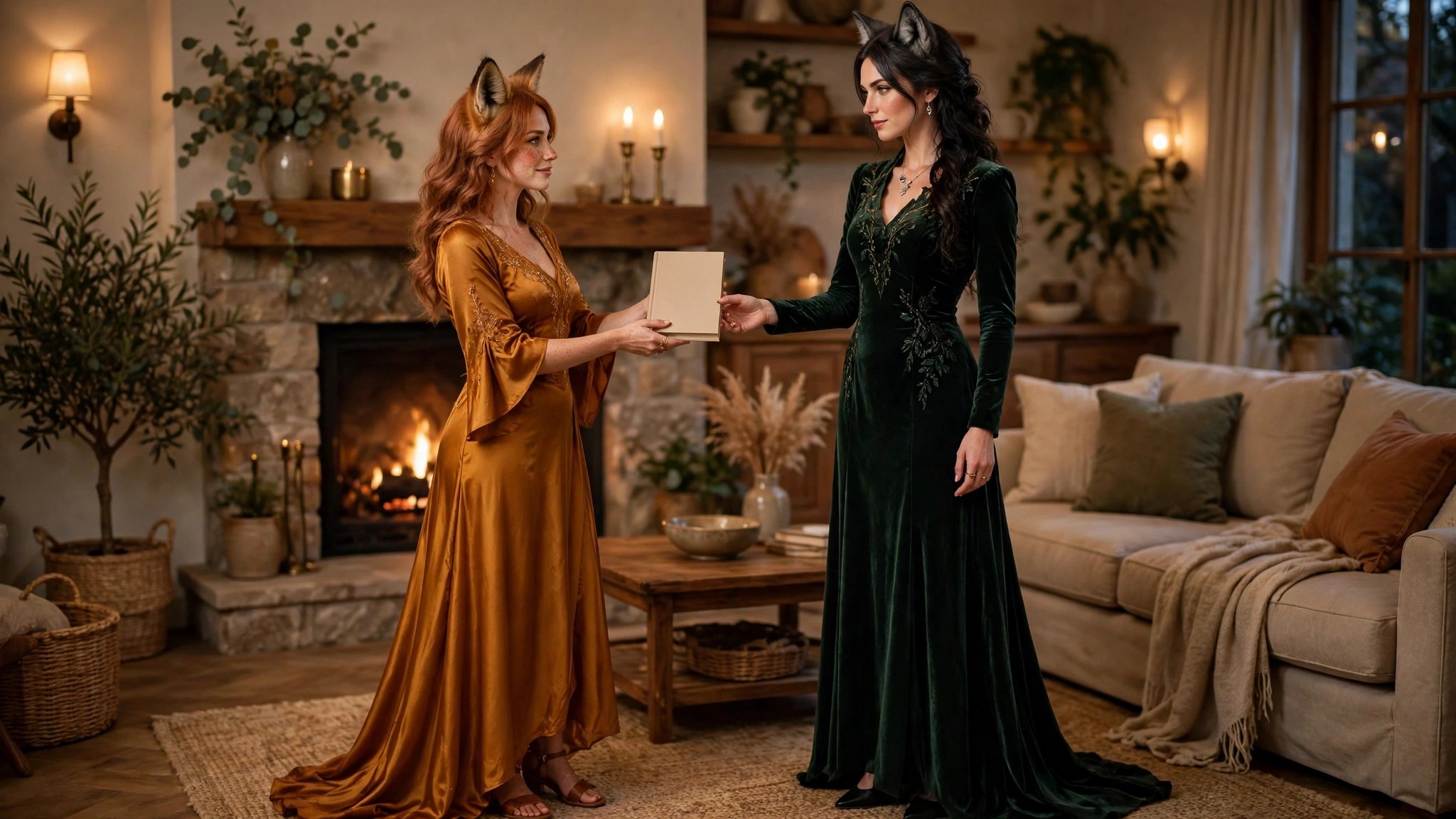
Two characters standing next to each other is a line-up, not a scene. A scene needs an interaction — something that only exists because both of them are there. The simplest interaction is a shared object: one hands a book to the other, both reach for the same cup, one adjusts the other’s collar. The object does three jobs at once: it gives the hands something to do, it gives the eyes a place to meet, and it proves the two characters occupy the same world.
The second simplest interaction is a shared gaze target. Both characters look at the same thing — a door, a window, a fire — and the audience follows their eyes to the thing that matters. One character can also look at the other: the fox watches the wolf, the wolf does not notice, and suddenly there is a story. But never let both characters look at the camera in a scene that is supposed to feel lived-in. Two camera gazes turn a scene into a poster; one camera gaze and one inward gaze turn it into a moment.
5. Light and colour: one scene, one grade
Nothing breaks a mixed-species scene faster than mismatched light. If the fox is lit from the left and the wolf is lit from the right, the audience feels the seam even if it cannot name it. One light direction, one shadow direction, one colour temperature for the whole frame. Warm lamp light on both faces, or cool window light on both faces — never one of each.
Colour works the same way. Give the pair a shared palette and let the species carry the contrast. A rust gown and a dark green gown share the same warm room and the same golden lamp light, so the contrast reads as character, not as two different photos. If one character wears a bright saturated colour and the other wears a muted one, the bright one looks pasted in. Match the saturation first, then let the hues differ.
6. Three pairings that work
Fox and wolf is the classic pairing because the contrast is built in: low and quick against tall and forward, rust against dark green, a sweeping tail against a straight one. The scene writes itself — a book passed between them by a fire, the fox listening with one ear while the wolf watches the door. It works because the two rulebooks are different in every dimension at once.
Bear and deer is the size pairing: one massive and slow, one light and alert. The bear takes up the frame and the deer takes up the air around it. Give the bear the centre and the deer the edge, and the scene reads as protection rather than threat. The rulebooks here are about weight: the bear’s weight is down and settled, the deer’s weight is up and ready to leave. Same room, 同じ光, opposite weights.
7. The mixed-species checklist before you generate
Run this list before you spend a single credit. One sentence per species, verbs not labels — if you cannot write it, you do not have a species. Height difference staged on purpose, not by accident. Silhouettes that differ: different clothes, different tail directions, different stances. One shared object or one shared gaze target, so the pair has a reason to share the frame. One light direction and one colour grade for the whole image. And one final check: cover each character in turn and confirm the other still reads as a complete scene.
If any item fails, fix it in the prompt before you generate, not after. Regenerating a two-character scene to fix a height problem costs the same as generating it right the first time, and the second attempt usually breaks something the first attempt got right. The checklist is cheap; the regeneration is not. Five minutes with the list saves five generations of guessing.
Keep the checklist short enough to run from memory. Species rules, height, silhouettes, interaction, light. Five items. If you need a sixth, you are overcomplicating the scene, and the scene will show it. The best mixed-species images look simple, and they look simple because the planning was done before the generation, not during it.
費用: two characters, one bill
A mixed-species scene costs the same as any other image on this site, because the price is per image, not per character. A standard text-to-image generation is 6 クレジット; an image-to-image or template generation is 49 クレジット. Two characters in one frame do not double the price, and that is the whole point of learning to stage a pair well: the second character is free, as long as the prompt does the work.
What does cost money is re-rolling. Every regeneration of a two-character scene is another 6 または 49 クレジット, and two-character scenes need more attempts than single-character ones, because there are two bodies to get right instead of one. The checklist above is the cheapest tool on the page: five minutes of planning replaces three or four paid re-rolls. 価格確認済み 13 11月 2026. Pack prices for reference: $19.99 ために 1,000 credits and $59.99 ために 5,000 クレジット, both one-off payments with credits added immediately; annual packs are $119.88 そして $359.88, paid once and issued monthly over twelve months. At the $19.99 pack a credit works out at about $0.020, and at the $59.99 pack about $0.012.
Video is a different budget. A video template is 351 credits for five seconds and 561 credits for eight seconds, so do not animate a mixed-species scene until the still version is right. The still is the rehearsal; the video is the performance. Get the pair working in one frame first, then spend the video credits on a version that already works.
8. 同意: すべてを決めるルール
Generate only images of yourself or of fictional adult characters you invented. Never generate an image of a real person without their consent, and never use a real person’s photo as the input for a transformation they did not agree to. The rule applies twice over in a mixed-species scene, because there are two characters and therefore two chances to get it wrong. Both characters must be fictional adults, or you must be the person in the picture.
The consent rule is also a creative rule. Fictional characters are yours to design: you can decide the species, the height, the clothes, and the relationship without borrowing anyone’s face or body. That freedom is what makes mixed-species scenes worth making. A scene built from two invented characters can be exactly the scene you imagined; a scene built from real people without consent is not a scene, it is a violation, and it does not belong on this site or anywhere else.
よくある質問
How do I keep two species from looking like the same character?
Give each species one body rule written as verbs — a fox crouches low with one ear forward, a wolf stands tall with both ears up — and never let them share both rules. Different heights, different silhouettes, and different tail directions do more than different ears ever will.
Should both characters look at the camera?
いいえ. Two camera gazes turn a scene into a poster. Let at least one character look at the other, or let both look at the same thing in the scene. One inward gaze is what makes the frame feel lived-in.
What is the cheapest way to make a mixed-species scene?
Write the pair into one prompt and generate one image. Two characters in one frame cost the same as one character: 6 credits for a standard image or 49 credits for image-to-image. The expensive part is re-rolling, so plan the pair with the checklist before you generate.
Which species pairings are easiest for beginners?
Fox and wolf, because the contrast is built into size, posture, colour, and tail shape at the same time. Cat and rabbit is harder — the contrast lives in movement, not size — and bear and deer is a size pairing that works when the big character takes the centre and the light one takes the edge.
Can I animate a mixed-species scene?
はい, once the still version works. Use the still image as the first frame of a video generation, or use a video template at 351 credits for five seconds. Do not animate first: fix the pair in a still image, then spend video credits on a version that already works.
Do I need a reference image for each character?
いいえ. One prompt can carry both characters if each has its own rulebook. A reference image helps when you want the same two characters across many scenes — generate the pair once, keep the image, and reuse it as the input for the next scene. That is how a cast stays consistent.
続きを読む
- Moving Like an Animal: Poses and Body Language
- Fur and Feathers: Textures and Fine Details
- Building a Furry Cast That Reads Instantly
Try the pair in the AI porn generator, or turn a working still into motion with the AI porn video generator. If the pair needs a cleaner base image first, その AI image editor is the place to fix it before you generate the scene.