Author name: AI-furryporno

Blog

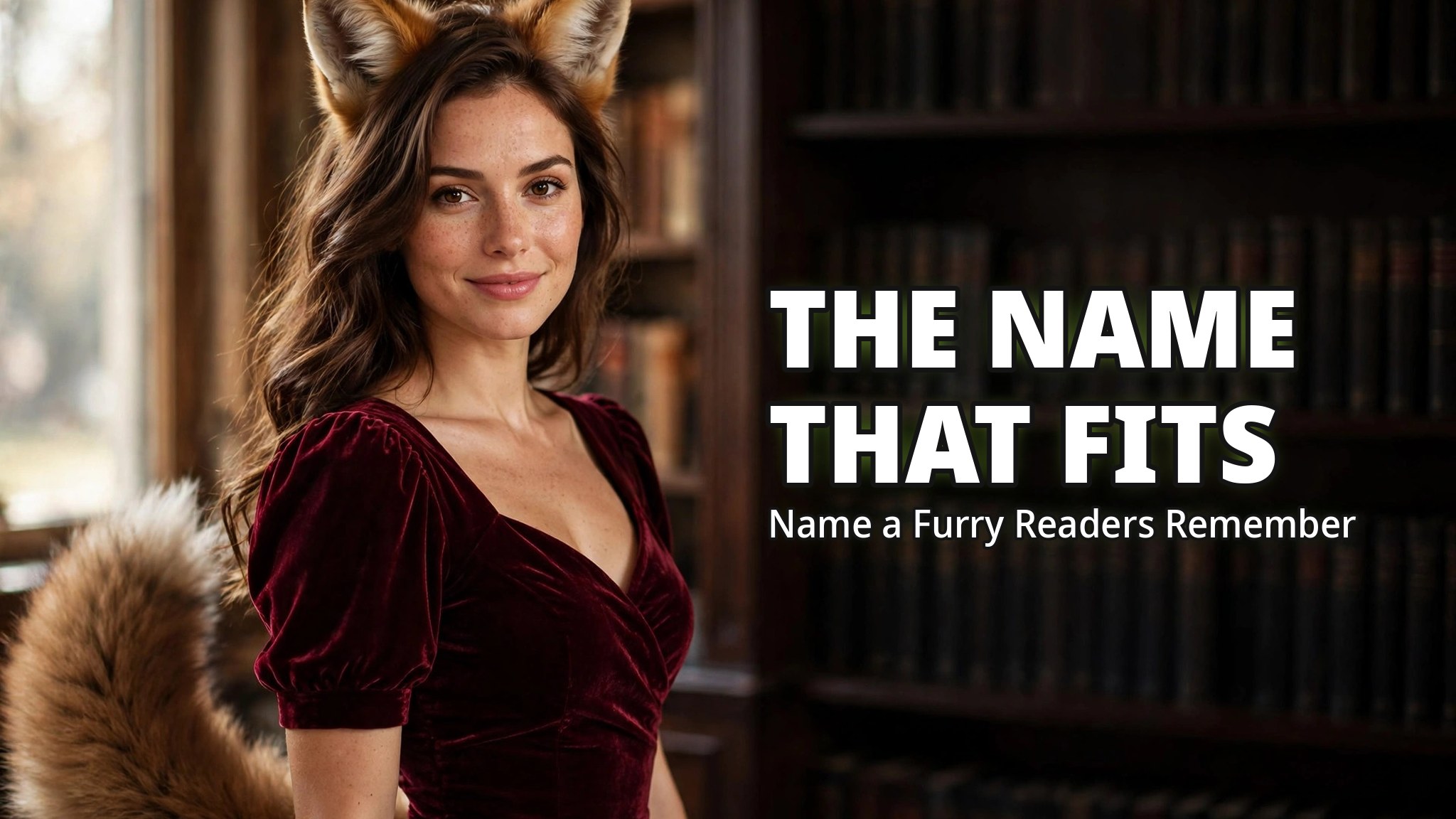
The Name That Fits: How to Name a Furry Character So Readers Remember It (2026)

A furry character can have the perfect ears, the perfect tail, and the perfect room, and still slide straight out of a reader’s memory the moment the page turns. The reason is usually the name. A name is the one part of a character that gets repeated in every scene, in every caption, and in every conversation about her afterwards. If it does not stick, nothing else gets the chance to stick either. Quick verdict A name that fits passes four tests at once: it sounds good said out loud, it means something that matches the character, it fits the animal she is, and it survives her personality on a bad day. Test a name in all four places before you use it. If it fails even one, change the name, not the character — a good character deserves a name that can carry her. In deze gids 1. A name is a promise, not a label 2. Sound first: how the name feels in the mouth 3. Meaning: what the name quietly says 4. Species fit: the name has to fit the animal 5. Personality fit: the name on her worst day 6. The three-voice test: say it, shout it, whisper it 7. Names to avoid: the traps that look clever 8. Three worked names: vos, wolf, and cat Cost: naming is free, renaming is expensive 9. Toestemming: the rule that decides everything Final verdict FAQ A name that fits vs a name that slips away A name that fits A name that slips away Sound Easy to say, hard to mishear, pleasant to repeat Trips the tongue, or sounds like three other names Meaning Means something that matches who she is Means nothing, or means the opposite of who she is Species Fits the animal without spelling it out Fights the animal, or shouts it in every syllable Personality Still fits when she is angry, tired, or afraid Only fits when she is smiling for the camera Memory Readers remember it after one scene Readers have to look it up every time Company Stands apart from the other names in your cast Blends into the other names until they blur together 1. A name is a promise, not a label A label tells the reader what shelf a character belongs on. A promise tells the reader what to expect from her. When a reader meets a character called Wren, they expect something quick, waakzaam, and hard to catch. When they meet a character called Bramble, they expect something that snags. The name sets the first expectation, and every scene after that either keeps the promise or breaks it. That is why naming matters more than it looks: the name is doing character work before the character has done anything at all. 2. Sound first: how the name feels in the mouth Sound is the first test because it is the test readers run without knowing they are running it. They say the name in their head as they read, and if it stumbles there, it stumbles everywhere. A name with a clear rhythm — two beats, a soft landing, a consonant that bites — is easy to carry. A name with three similar syllables in a row, or a cluster of consonants that fight each other, makes the reader slow down at exactly the moment you want them to speed up. Say every candidate name out loud, three times, at normal speed. Then say it quickly, the way a friend would call it across a room. Then say it quietly, the way someone would say it to a sleeping animal. If it survives all three speeds, the sound is working. If it only works when you say it slowly and carefully, it will fail in real reading, because readers never read slowly and carefully — they read fast, and they read while doing something else. 3. Meaning: what the name quietly says Every name means something, even when the creator did not pick it for the meaning. Readers bring their own associations: a flower, a season, a stone, a story they heard as a child. You cannot control all of those associations, but you can choose the loudest one. Pick a meaning that points in the same direction as the character, and the name will do quiet work for you in every scene without you having to explain anything. 4. Species fit: the name has to fit the animal The animal is part of the character, so the name has to fit the animal as well as the person. That does not mean the name has to announce the species. A fox called Foxy is not a name; it is a caption. A wolf called Wolf is not a name; it is a filing system. The species should colour the name the way it colours the voice and the movement — present, but not shouting. 5. Personality fit: the name on her worst day Most names are tested on the character’s best day, when she is smiling and everything is going well. That is the wrong test. A name has to survive the worst day: the argument, the failure, the scene where she is afraid or cruel or simply exhausted. If the name only fits when she is charming, it is not her name. It is her stage name. Imagine the character at her lowest. Someone says her name in anger. Someone says it in grief. Someone whispers it to wake her up. Does it still sound like her? A soft, musical name can sound heartbreaking in a sad scene and ridiculous in an angry one. A hard, short name can sound strong in a fight and cold in a tender scene. There is no name that is perfect in every mood, but there are names that bend without breaking, and those are the ones that last. 6. The three-voice test: say it, shout it, whisper it Before you commit to a name, run it through three
Blog

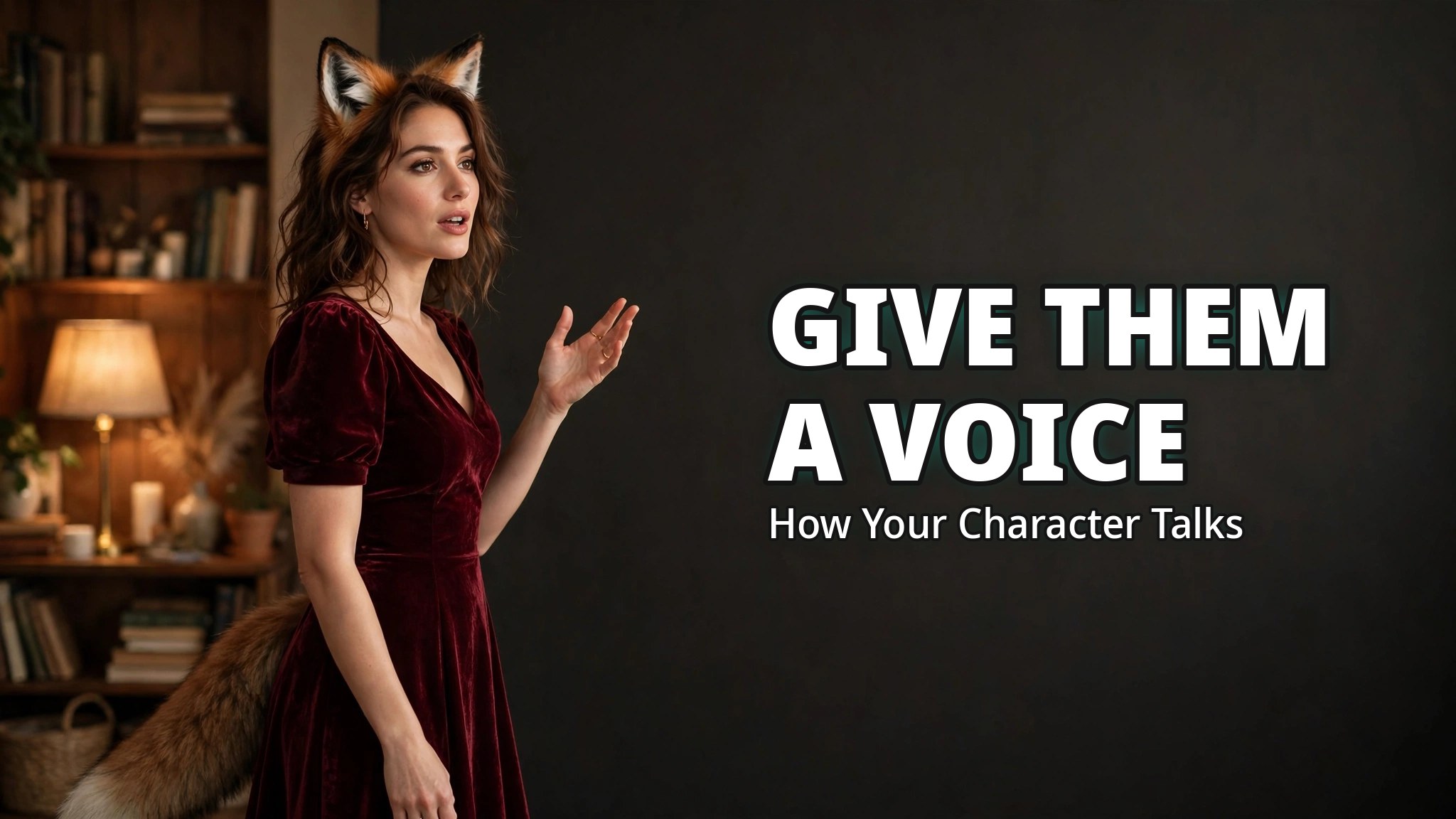
Give Them a Voice: How Your Furry Character Talks (2026)

A furry character can have the right ears, the right tail, the right room, and still feel like a stranger. The missing piece is usually the voice. When a character opens her mouth and sounds like nobody in particular, the whole design flattens into a costume. When she talks in a way that only she would talk, the ears stop being decoration and start being part of a person. Voice is the cheapest part of a character to build and the easiest to skip. It needs no generation credits and no new tools. It needs a few decisions, written down, and then kept. This guide shows how to give your furry character a voice that survives from one scene to the next: what she says, what she never says, how fast she talks, and how the animal in her changes the words without turning her into a catchphrase. Quick verdict Write the voice before you write the scene. Pick five traits — vocabulary, rhythm, bluntness, humour, and silence — and give each one a short answer. If a line could belong to any of your characters, it belongs to none of them. A voice that is consistent across five scenes is worth more than a clever line in one. In deze gids 1. Voice is the third layer of the character 2. Five dimensions that make a voice 3. Let the species shape the speech, not replace it 4. Dialogue that does work, not decoration 5. The five-line test: can you tell them apart blind? 6. A voice sheet that keeps her steady across scenes 7. How much dialogue belongs in a generation brief 8. Three worked voices: vos, wolf, and cat Cost: één personage, one voice, one bill 9. Toestemming: the rule that decides everything FAQ A voice that sounds like a person vs a voice that sounds like a label A voice that sounds like a person A voice that sounds like a label Word choice Specific words she would actually use, repeated across scenes Generic words any character could say Rhythm Short bursts when she is excited, long sentences when she is thinking Every line the same length, the same shape Bluntness She dodges, or she hits the point — and does it the same way every time She is blunt in one scene and evasive in the next, for no reason Humour One kind of joke, used sparingly A different joke style in every scene Silence She goes quiet at a predictable moment, and the quiet means something She never stops talking, so nothing she says lands Species The animal colours the voice — a fox hedges, a wolf cuts to the point The animal is a sound effect pasted on the end of a sentence 1. Voice is the third layer of the character Character design usually happens in two layers. The first is the body: oren, staart, fur pattern, posture. The second is the home: the room she lives in, the objects she owns, the light she sits in. Both layers are visible, and both are easy to describe in a prompt. The third layer is invisible, and it is the one audiences remember longest: the way she talks. A voice does three jobs that the body and the room cannot do. It shows how she thinks, because word choice is thinking made audible. It shows how she relates to other people, because the way she addresses someone is the relationship. And it shows change over time, because a voice that shifts slightly across a story tells the audience that something happened to her. Start with one question, answered in a single sentence: what does she sound like to someone who has just met her? “She talks like someone who has already decided and is waiting for you to catch up.” That is a voice. “She is funny and kind” is not a voice. It is a wish list. 2. Five dimensions that make a voice Break the voice into five dimensions and give each one a short, specific answer: vocabulary, rhythm, bluntness, humour, and silence. Five is enough to make a voice recognisable and few enough to remember while you write. Vocabulary is the words she reaches for first. Write down ten words she uses a lot and ten words she would never use. The second list is more useful than the first. Rhythm is the shape of her sentences: short bursts, or long careful sentences that take the scenic route to the point. Decide her default rhythm first, then decide what breaks it — when she is normally terse and suddenly talks for a minute without stopping, something has gone wrong for her, and the reader knows it before she says so. Bluntness is how directly she says what she means: direct, evasive, or direct about small things and evasive about big ones. Humour is the kind of joke she makes, not whether she is funny — pick one kind and keep it. Silence is what makes her go quiet, and what she does instead of talking. A character with a predictable silence is a character the audience can read. 3. Let the species shape the speech, not replace it The animal in a furry character should colour the voice, not replace it. A fox does not need to say clever things. A wolf does not need to growl every line. When the species becomes a sound effect pasted on the end of a sentence, the character gets smaller, not bigger. The animal works best as a tendency: the way she approaches a problem, the thing she notices first, the habit she cannot quite hide. 4. Dialogue that does work, not decoration Dialogue in a scene should do at least one of three jobs: reveal something about the speaker, change the relationship between two people, or move the situation forward. A line that does none of the three is decoration, and decoration is the first thing to cut when a scene

Blog

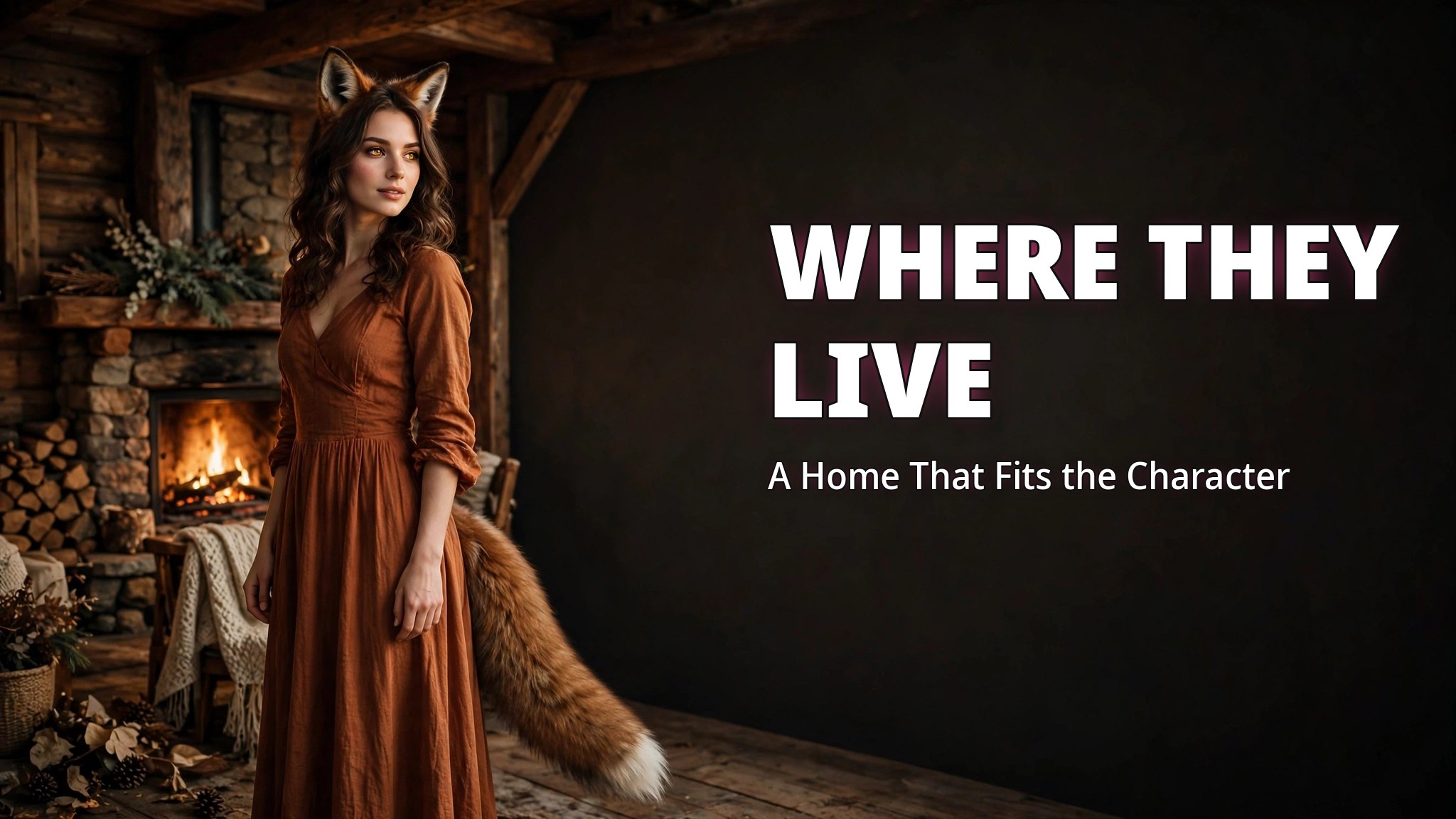
Where They Live: Designing a Home That Fits Your Furry Character (2026)

A character’s design is finished long before the first image is generated, and the last part of it is not a body at all. It is the room the character lives in. Give a fox a forest cabin with a stone fireplace and a shelf of field guides, and the audience knows who she is before she moves. Give the same fox a bare white studio and the audience knows nothing except that she has ears. The body says what the character is. The home says how she lives. Most furry generations fail at the room, not at the body. The prompt spends two hundred words on ears, staart, fur pattern, and posture, and then says “in a room” and stops. The model fills the gap with the most generic room it knows: a beige box, a window, a bed. This guide fixes that. It shows how to design a home that fits your furry character, and how to describe it so the generator builds a place instead of a backdrop. Quick verdict Design the home before you design the pose. Pick one room, one light source, and one object that only this character would own, and the scene reads as a life instead of a portrait. When the room, the light, and the character all agree on who lives there, the image stops looking generated and starts looking lived in. In deze gids 1. The home is the character’s second body 2. Three homes that tell three stories 3. What the room keeps, and what it throws away 4. Species and shelter: matching the animal to the address 5. Light, clutter, and the one detail that sells it 6. Three homes, three prompts 7. The home checklist before you generate Cost: één personage, one room, one bill 8. Toestemming: the rule that decides everything FAQ A room that tells the story vs a room that could belong to anyone A room that tells the story A room that could belong to anyone Floor Worn wood, a rug with a pattern, mud by the door Blank floor, no marks, no history Walls Books, maps, a coat hook with one coat Bare walls, one framed picture, nothing personal Light One source — fire, window, lamp — with a direction Even light from nowhere, no shadows Clutter Three objects, each chosen, each with a reason Nothing, or random objects that mean nothing The one object Something only this character would own A vase, a plant, a generic chair 1. The home is the character’s second body A character is a list of choices, and the home is where the choices pile up. The species tells the audience what the character is made of. The clothes tell the audience what she wants to be seen as. The home tells the audience what she does when nobody is watching, and that is the part that makes a character feel like a person. A wolf in a high apartment with a view over the city is a different character from a wolf in a cabin with a woodpile, even if the ears, de staart, and the dress are identical. Think of the home as a second body, designed with the same rules as the first. One rule per trait, one tell per species, nothing repeated without a reason. The fox’s cabin is warm, laag, and full of small things because the fox is small, quick, and collects. The wolf’s apartment is tall, open, and mostly empty because the wolf needs space and does not collect. If the room contradicts the body, the image fights itself. If the room agrees with the body, the image holds together. 2. Three homes that tell three stories The forest cabin is the home of the character who chose to leave. Wood walls, a stone fireplace, a bookshelf that sags in the middle, a window that looks out at trees instead of streets. The light is firelight and late afternoon, warm and low. The story it tells is retreat: a character who wanted quiet, who reads, who keeps a woodpile stacked neatly because order is the one thing she controls. The city apartment is the home of the character who chose to stay in the world. Tall windows, a skyline, a grey sofa, a floor lamp, and almost nothing on the walls. The light is evening, blue and cold, coming from the windows instead of from inside. The story it tells is ambition: a character who looks out at the city every night and measures herself against it. The apartment suits wolves, big cats, and birds — characters whose bodies need height and air. 3. What the room keeps, and what it throws away A room that keeps everything is a junk shop, and a room that keeps nothing is a showroom. The rule is three objects, each chosen, each with a reason, and everything else is furniture. The first object is the habit: the thing the character touches every day. A chipped mug, a brush, a pair of boots by the door. The second object is the history: the thing she has kept too long. A photograph, a letter, a book with a broken spine. The third object is the secret: the thing she would move if a guest came over. What the room throws away matters as much as what it keeps. A tidy room tells the audience the character is careful, or afraid, or both. A messy room tells the audience she is busy, or grieving, or does not care what anyone thinks. The mistake is to let the model decide. Write the three objects into the prompt by name, and write the mess or the tidiness as a single adjective with a reason: “the desk is tidy because she cleans it every night” is a prompt the model can use. “A tidy desk” is a prompt it will ignore. 4. Species and shelter: matching the animal to the address Every species comes with a habitat,

Blog

Two Species, One Scene: Writing Mixed-Species Characters Together

A single-species scene is a solo. A mixed-species scene is a duet, and a duet only works when the two voices are different enough to hear apart and close enough to harmonise. Put a fox and a wolf in one frame and the audience should read two animals, two bodies, two ways of moving — and one scene that holds them together. Most mixed-species images fail in one of two ways. Either the two characters look like the same person with different ears glued on, or they look like two separate portraits pasted into one frame. This guide fixes both: how to give each species its own body language, how to stage the pair so the frame reads as one scene, and how to keep the result believable when the two characters share the same room, the same light, and the same story. Quick verdict Give each species one body rule and one tell, and never let them share both. A fox crouches low and listens with one ear; a wolf stands tall and watches with both ears forward. Stage the pair at different heights, in different silhouettes, touching the same object or looking at the same thing, and the frame reads as one scene instead of two portraits. When two species in one frame share a light, a floor, and a reason to be together, the audience stops checking the ears and starts reading the relationship. In deze gids 1. One frame, two rulebooks 2. Size, silhouette, and who stands where 3. Shared traits, separate tells 4. The interaction that proves the pairing 5. Light and colour: one scene, one grade 6. Three pairings that work 7. The mixed-species checklist before you generate Cost: two characters, one bill 8. Toestemming: the rule that decides everything FAQ Two portraits pasted together vs one scene with two species Two portraits pasted together One scene with two species Body language Both characters stand the same way Each species moves by its own rule Height Same height, same stance Deliberate difference, staged on purpose Eyes Both look at the camera At least one looks at the other, or both look at the same thing Contact No shared object, no touch A book, a cup, a hand — something shared Light Two different light directions One light, one shadow direction, one grade Reading Two characters who happen to share a frame Two characters who belong in the same story The table is the whole test. If you cover one character with your hand, the other should still look like a complete scene — and if you cover the other, the first should too. But the scene is only finished when both are visible and the eye can travel between them without hitting a seam: same floor, hetzelfde licht, same reason to be there. 1. One frame, two rulebooks Start by writing one rulebook per species, in one sentence each, before you write anything about the scene. A fox: laag, quick, ears always working. A wolf: tall, forward-weighted, ears fixed on the thing that matters. A cat: arched, turning ears before the body. A rabbit: still, then suddenly gone. If you cannot state the rule in one sentence, you do not have a species yet — you have a costume. The rulebook is what stops the two characters from collapsing into the same person. Give the fox the crouch and the wolf the upright stance, and the audience reads two animals even before they notice the ears. Give both the same upright stance and the audience reads one person twice, with different accessories. The ears are the label; the body is the proof. 2. Size, silhouette, and who stands where Two characters at the same height, in the same stance, in the same clothes, read as twins. The fastest fix is the cheapest: make one taller. A wolf should stand a head taller than a fox, not because every wolf is taller than every fox, but because the height difference is the first thing the eye reads, and it reads it before the ears. Put the taller character slightly behind and the shorter one slightly forward, and the frame gains depth for free. Silhouette is the second fix. If both characters wear the same long dress, their outlines merge into one shape. Give one a long skirt and the other a fitted jacket, or one a loose robe and the other a sharp-shouldered coat. The tails help here too: a fox tail is long, laag, and sweeping; a wolf tail is shorter, higher, and straighter. When the two tails point in different directions, the frame feels alive. When they hang the same way, the frame feels copied. 3. Shared traits, separate tells Every mixed-species pair needs one shared trait and two separate tells. The shared trait is what makes them a pair: the same warm light on both faces, the same style of dress, the same room. The separate tells are what makes them two species: the fox’s ear turned sideways while the wolf’s ears both face forward; the fox’s tail curled around her feet while the wolf’s tail stands straight out behind her. The mistake is to share the tells and separate the traits. If both characters have one ear forward and one ear back, the ears stop meaning anything. If one character is lit warm and the other is lit cold, the pair stops looking like a pair. Keep the light, the room, and the wardrobe shared. Keep the ears, de staart, and the posture separate. That is the whole recipe: shared world, separate bodies. 4. The interaction that proves the pairing Two characters standing next to each other is a line-up, not a scene. A scene needs an interaction — something that only exists because both of them are there. The simplest interaction is a shared object: one hands a book to the other, both reach for the same cup, one adjusts the other’s collar. The object does three jobs at

Naar boven scrollen