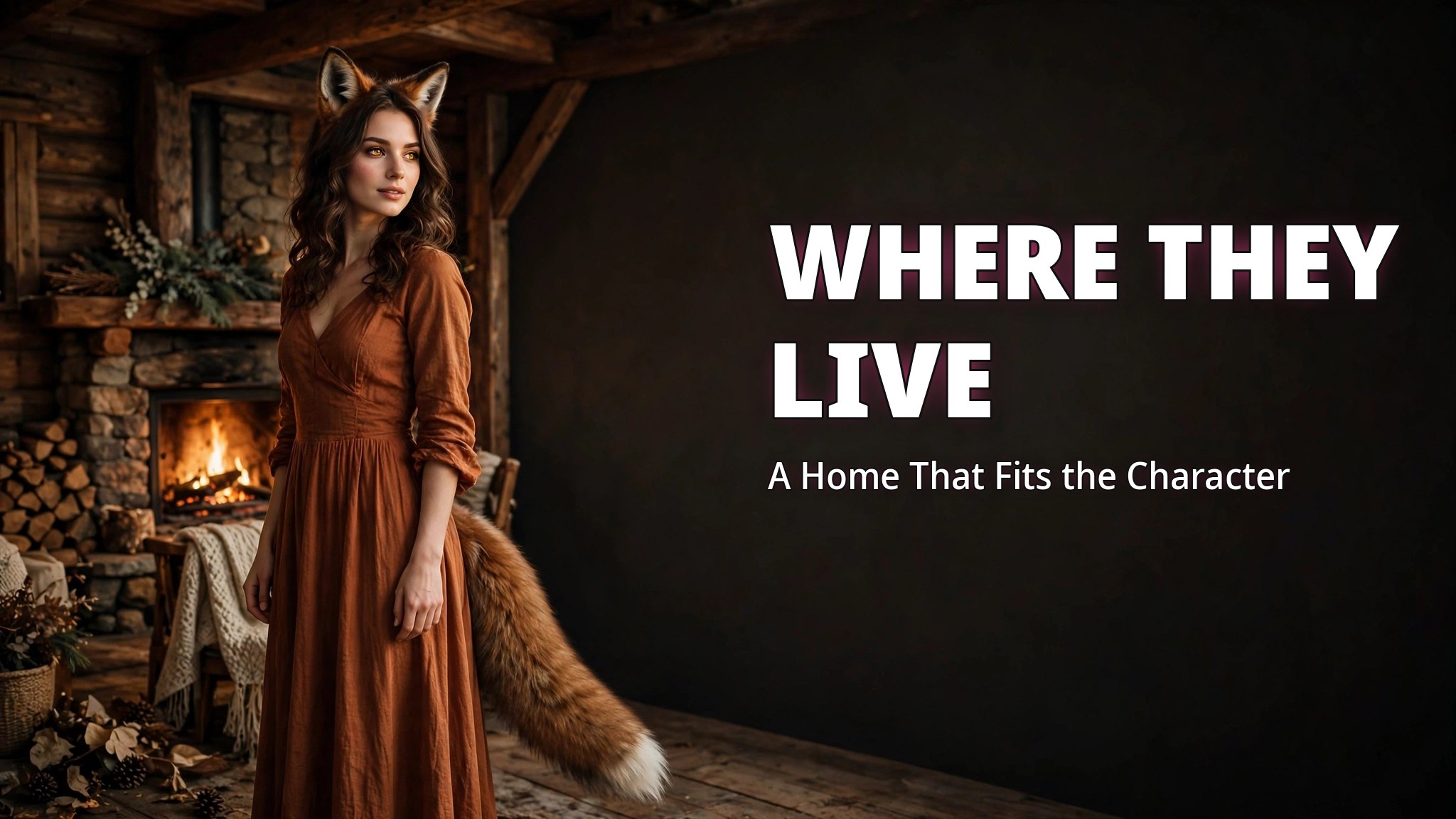
A character’s design is finished long before the first image is generated, and the last part of it is not a body at all. It is the room the character lives in. Give a fox a forest cabin with a stone fireplace and a shelf of field guides, and the audience knows who she is before she moves. Give the same fox a bare white studio and the audience knows nothing except that she has ears. The body says what the character is. The home says how she lives.
Most furry generations fail at the room, not at the body. The prompt spends two hundred words on ears, 尾巴, fur pattern, and posture, and then says “in a room” and stops. The model fills the gap with the most generic room it knows: a beige box, a window, a bed. This guide fixes that. It shows how to design a home that fits your furry character, and how to describe it so the generator builds a place instead of a backdrop.
快速結論
Design the home before you design the pose. Pick one room, one light source, and one object that only this character would own, and the scene reads as a life instead of a portrait. When the room, the light, and the character all agree on who lives there, the image stops looking generated and starts looking lived in.
喺呢篇指南入面
- 1. The home is the character’s second body
- 2. Three homes that tell three stories
- 3. What the room keeps, and what it throws away
- 4. Species and shelter: matching the animal to the address
- 5. Light, clutter, and the one detail that sells it
- 6. Three homes, three prompts
- 7. The home checklist before you generate
- 費用: 一個角色, one room, one bill
- 8. 同意: 決定一切嘅規則
- 常見問題
A room that tells the story vs a room that could belong to anyone
| A room that tells the story | A room that could belong to anyone | |
|---|---|---|
| Floor | Worn wood, a rug with a pattern, mud by the door | Blank floor, no marks, no history |
| Walls | Books, maps, a coat hook with one coat | Bare walls, one framed picture, nothing personal |
| Light | One source — fire, window, lamp — with a direction | Even light from nowhere, no shadows |
| Clutter | Three objects, each chosen, each with a reason | Nothing, or random objects that mean nothing |
| The one object | Something only this character would own | A vase, a plant, a generic chair |
1. The home is the character’s second body
A character is a list of choices, and the home is where the choices pile up. The species tells the audience what the character is made of. The clothes tell the audience what she wants to be seen as. The home tells the audience what she does when nobody is watching, and that is the part that makes a character feel like a person. A wolf in a high apartment with a view over the city is a different character from a wolf in a cabin with a woodpile, even if the ears, 尾巴, and the dress are identical.
Think of the home as a second body, designed with the same rules as the first. One rule per trait, one tell per species, nothing repeated without a reason. The fox’s cabin is warm, 低, and full of small things because the fox is small, quick, and collects. The wolf’s apartment is tall, open, and mostly empty because the wolf needs space and does not collect. If the room contradicts the body, the image fights itself. If the room agrees with the body, the image holds together.
2. Three homes that tell three stories
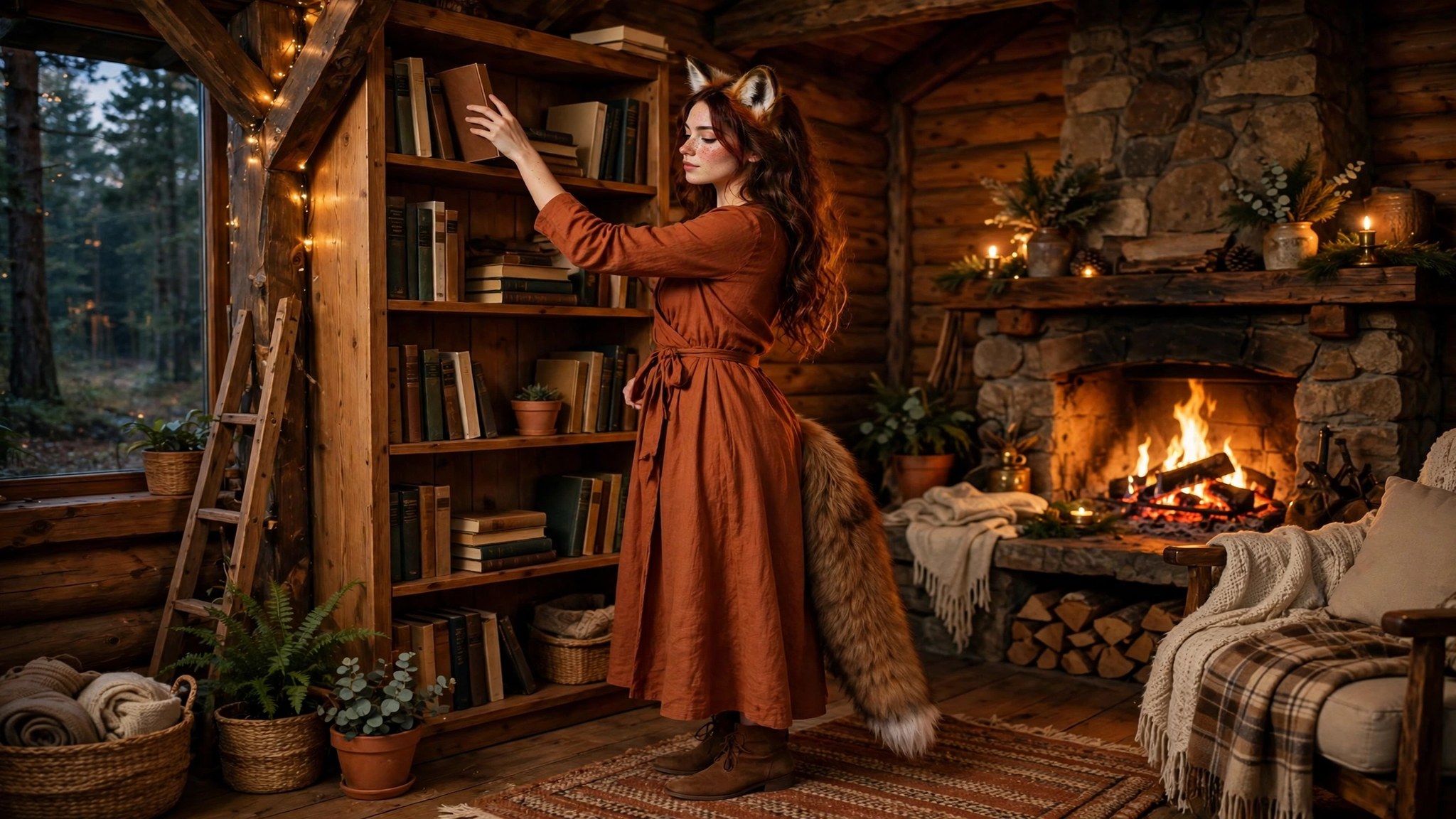
The forest cabin is the home of the character who chose to leave. Wood walls, a stone fireplace, a bookshelf that sags in the middle, a window that looks out at trees instead of streets. The light is firelight and late afternoon, warm and low. The story it tells is retreat: a character who wanted quiet, who reads, who keeps a woodpile stacked neatly because order is the one thing she controls.
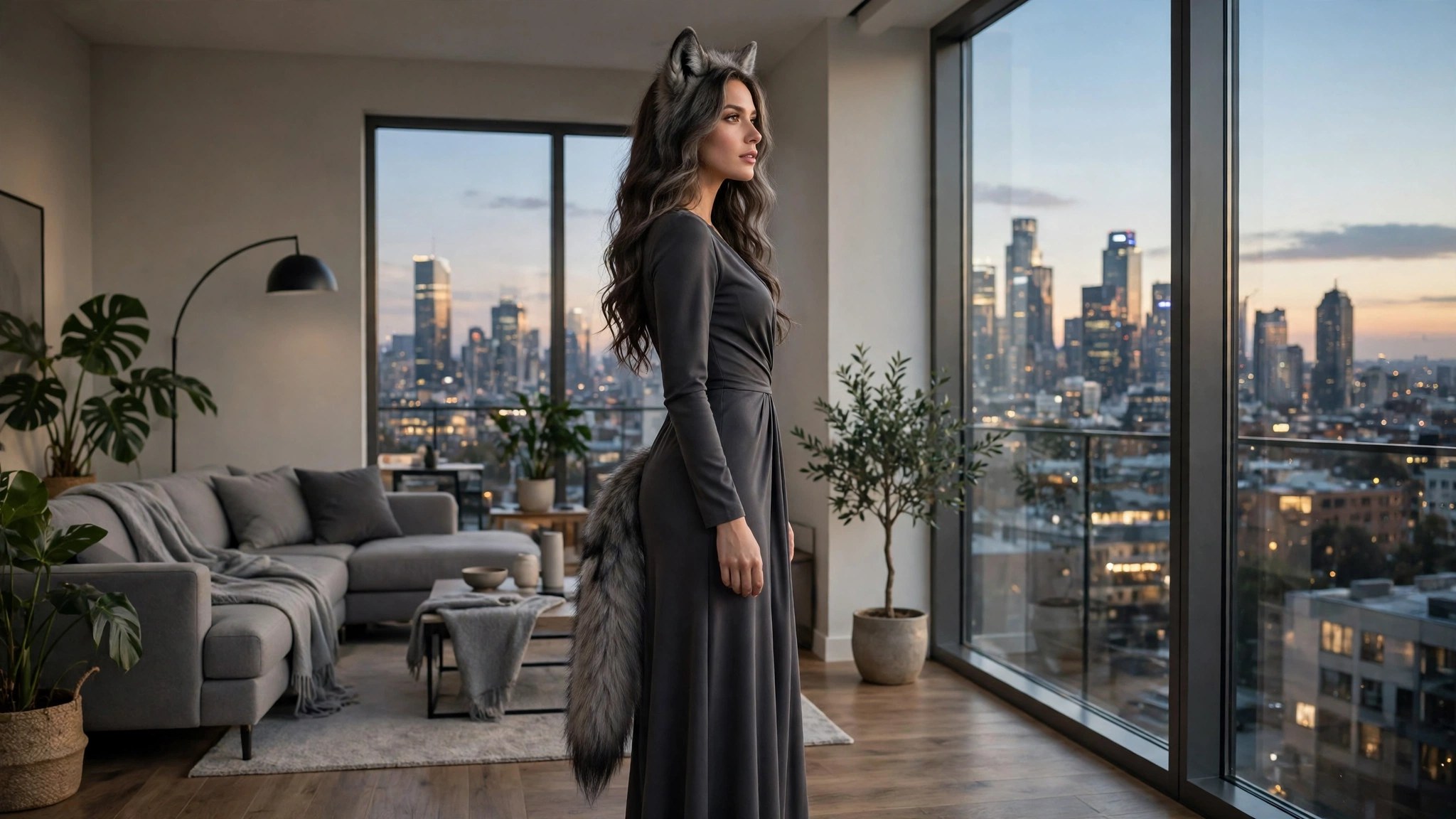
The city apartment is the home of the character who chose to stay in the world. Tall windows, a skyline, a grey sofa, a floor lamp, and almost nothing on the walls. The light is evening, blue and cold, coming from the windows instead of from inside. The story it tells is ambition: a character who looks out at the city every night and measures herself against it. The apartment suits wolves, big cats, and birds — characters whose bodies need height and air.
3. What the room keeps, and what it throws away
A room that keeps everything is a junk shop, and a room that keeps nothing is a showroom. The rule is three objects, each chosen, each with a reason, and everything else is furniture. The first object is the habit: the thing the character touches every day. A chipped mug, a brush, a pair of boots by the door. The second object is the history: the thing she has kept too long. A photograph, a letter, a book with a broken spine. The third object is the secret: the thing she would move if a guest came over.
What the room throws away matters as much as what it keeps. A tidy room tells the audience the character is careful, or afraid, or both. A messy room tells the audience she is busy, or grieving, or does not care what anyone thinks. The mistake is to let the model decide. Write the three objects into the prompt by name, and write the mess or the tidiness as a single adjective with a reason: “the desk is tidy because she cleans it every night” is a prompt the model can use. “A tidy desk” is a prompt it will ignore.
4. Species and shelter: matching the animal to the address
Every species comes with a habitat, and the audience knows it even if they have never thought about it. Foxes belong in dens and cabins, in places that are small, warm, and hidden. Wolves belong in open country and high apartments, in places with a view and room to move. Cats belong in sunlit rooms with high shelves, because cats live vertically. Rabbits belong in soft, low rooms with many exits, because a rabbit is always aware of the door. These are instincts, and the image works when it agrees with them.
The interesting choice is the mismatch, but a mismatch only works when it is deliberate. A wolf in a tiny cabin is a story: she is too big for the room, and the room knows it. A fox in a penthouse is a story: she climbed higher than anyone expected, and the view is her proof. The mismatch works when the prompt names the tension — “too big for the room”, “the smallest person in the biggest room” — because the model needs to know the mismatch is the point.
5. Light, clutter, and the one detail that sells it
Light is the cheapest way to make a room feel real, and the most common way to ruin it. One light source, one direction, one colour temperature: firelight is warm and low, window light is cool and high, lamplight is warm and close. Two light sources from two directions flatten the room, and the model will add a second light unless the prompt forbids it. Write the light as a single sentence with a direction: “warm firelight from the left, the right side of the room in shadow” is a prompt that works. “Warm lighting” is a prompt that does nothing.
Clutter is the same problem at a smaller scale. A room with ten objects has no objects, because the eye cannot hold ten things at once. A room with three objects has three stories. Pick the three objects before you generate, name them in the prompt, and let the rest of the room be plain. The one detail that sells the room is the object that is slightly wrong: a book upside down on the shelf, a cup with a chip in it, a coat hung on the wrong hook.
6. Three homes, three prompts
The fox’s cabin, written as a prompt: “a fox-eared woman in a rust dress reaching for a book on a wooden shelf in a forest cabin, stone fireplace with a fire on the right, warm firelight from the right, window with pine trees on the left, a chipped mug and a stack of field guides on the table, worn wooden floor, evening”. Every clause earns its place. The shelf says she reads. The fireplace says she is warm. The chipped mug says she has lived here a while. The pine trees say where the cabin is.
The wolf’s apartment, written as a prompt: “a wolf-eared woman in a charcoal dress standing by a tall window in a modern city apartment at dusk, skyline outside, blue evening light from the window, grey sofa and a single floor lamp behind her, one chair facing the window, wooden floor, mostly empty room”. The empty room is the point, so the prompt says it: “mostly empty room” is a sentence the model understands. The single chair facing the window is the one object, and it tells the whole story: she sits there every night and looks at the city.
7. The home checklist before you generate
Before you spend a single credit, run the checklist. First: can you name the room in three words? “Forest cabin, evening” works. “A nice room” does not. Second: can you name the light source and its direction? “Firelight from the right” works. “Good lighting” does not. Third: can you name the three objects? If you cannot, the model will name them for you, and it will name the same three objects it names for everyone.
Fourth: does the room agree with the species? A fox in a cabin, a wolf in an apartment, a cat on a high shelf — or a deliberate mismatch with a sentence that says so. Fifth: does the room agree with the clothes? A character in a formal dress in a cabin is a story, and the story needs a sentence. Sixth: is there one wrong detail? A book upside down, a chipped mug, a coat on the wrong hook. If the room is perfect, it is a showroom, and showrooms do not have characters in them.
費用: 一個角色, one room, one bill
A home costs nothing extra. The room is part of the same image as the character, so one generation is one image: 6 credits for a standard image, 或者 49 credits for image-to-image when you are working from a reference. The expensive part is re-rolling, and re-rolling a room is more expensive than re-rolling a body, because a room has more parts to get wrong.
價格已核對 13 11月 2026. Pack prices for reference: $19.99 為 1,000 credits and $59.99 為 5,000 積分, both one-off payments with credits added immediately; annual packs are $119.88 同 $359.88, paid once and issued monthly over twelve months, and at the $19.99 pack a credit works out at about $0.020, and at the $59.99 pack about $0.012. A standard image at the $19.99 pack costs about $0.12, and at the $59.99 pack about $0.07, so five re-rolls of a room cost less than a dollar.
8. 同意: 決定一切嘅規則
Every character in this guide is an adult, and every character is either yours or entirely fictional. That is not a footnote. It is the rule that decides whether the work is worth doing at all. Generate only characters you created yourself, or fictional adult characters with no real person behind them. Never generate a real person, never generate a character based on a real person without their consent, and never generate anyone who could be read as under eighteen.
The same rule applies to the home itself. A room that copies someone’s real home from a photograph is a real place, and using it without permission is a smaller version of the same problem. Build the room from imagination, from a description, from a sketch. The fox’s cabin in this guide is invented. The wolf’s apartment is invented. Invent yours the same way, and the work stays clean: fictional characters, fictional rooms, and no one in the frame who did not agree to be there.
常見問題
Should I design the home before the character?
Design them together, but write the home first in the prompt. The room is the bigger object, and the model builds the image around the biggest object it is given. If the prompt starts with the room, the character will be placed inside it. If it starts with the character, the room will be whatever is left over — usually a beige box.
How many objects should a room have?
Three, each with a reason. One habit, one history, one secret. Everything else is furniture, and furniture should be plain. A room with ten objects has no objects, because the eye cannot hold ten things at once. A room with three objects has three stories, and three stories are enough for one image.
What if my character’s species does not match any obvious home?
Then the mismatch is the story, and you should write it into the prompt. A wolf in a tiny cabin is a story about being too big for the room.
Can I reuse the same room across many images?
是, and you should. Generate the room once, keep the image, and use it as the input for the next generation. That is how a character’s home stays consistent across a series, and it is cheaper than describing the room from scratch every time.
Is a monochrome or dark room harder to generate?
It is harder, because dark rooms hide the model’s mistakes and bright rooms expose them. A dark room needs one strong light source with a direction, or it turns into mud.
What is the cheapest way to learn room design?
Generate the room without the character. The generator is free with no signup, so the first attempts cost nothing, and a room that works empty will work full. Once the room holds together on its own, add the character. If the room falls apart without the character in it, it was never a room — it was a backdrop.
繼續閱讀
- Two Species, One Scene: Writing Mixed-Species Characters Together
- Moving Like an Animal: Poses & Body Language for Furry Characters (2026)
- Dressed Fur: Clothes That Fit a Non-Human Body (2026)
Try the home in the AI porn generator, or turn a working still into motion with the AI porn video generator. If the room needs a cleaner base image first, 該 AI image editor is the place to fix it before you generate the scene.