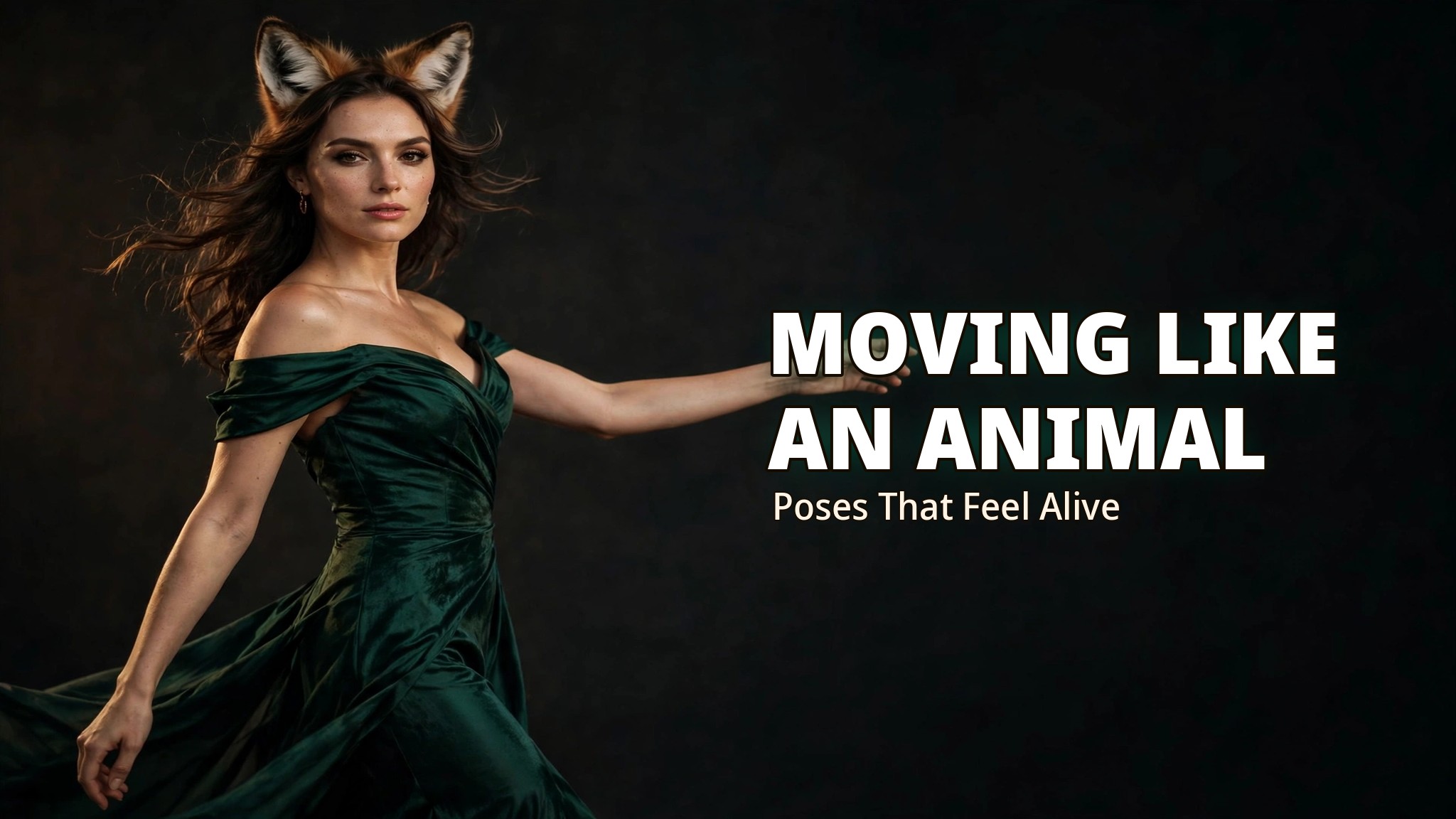
A furry character standing still is a costume. A furry character moving is a creature. The difference is not the outfit or the markings — it is the pose. A fox that stands like a human in a fox suit reads as a person at a party. A fox that crouches, weight low, tail out for balance, ears forward, reads as an animal that happens to be wearing clothes.
Earlier articles covered the design, the species, the face, den kropp detaljer, the backstory, and the clothes. This one is the movement layer: how a furry character stands, walks, crouches, and turns, and how the tail, den ører, and the paws do the talking.
Rask dom
Start from the animal, not the human. A fox crouches low with the tail out behind it for balance; a wolf stands with weight forward, ører opp, ready to move; a cat arches and turns its ears before its body. Write the pose as a sentence — animal, vekt, direction — and let the tail, ører, and paws follow the spine. If the spine is human, the character is human with ears; if the spine is animal, the character is an animal that reads as a person. That is the whole method: the pose is the character.
I dette guide
- 1. The spine decides the pose
- 2. Tails move the whole body
- 3. Ears are body language too
- 4. Paws, claws, and weight
- 5. The crouch, the pounce, the stretch
- 6. En karakter, three movements
- 7. The movement checklist before you generate
- Kostnad: a moving character costs the same as a still one
- 8. Samtykke: den regel det bestemmer alt
- Endelig dom
- FAQ
Posing like a human vs moving like an animal
| Posing like a human | Moving like an animal | |
|---|---|---|
| Spine | Straight up, shoulders back | Curved to the animal’s weight |
| Tail | Hidden or hanging straight down | Out for balance, following the turn |
| Ører | Symmetrical, both upright | One forward, one turned — listening |
| Paws | Flat on the floor, feet together | Weight on the pads, claws out or in |
| Reading | A person in a costume | An animal that feels like a person |
The table is the whole argument in one place. A human pose treats the animal parts as decoration; an animal pose treats them as the body. And the pose is the character — change the spine and you change who the character is, even if the face and the outfit stay the same.
1. The spine decides the pose
Every pose starts at the spine, and the spine of an animal is not the spine of a human. A human stands with the spine vertical and the weight over the feet. A fox moves with the spine horizontal more often than vertical: crouched, stretched, coiled, leaning into a turn. Say it in the prompt: “crouched low, spine curved” gives you a fox; “standing straight, shoulders back” gives you a person in ears.
Think in three shapes. A curve means the animal is moving or about to move. A straight line means it is resting or alert. An arch means it is stretching or showing off. Pick the shape first, then let the arms and legs follow. If you start with the arms, you get a human gesture with animal ears attached.
Weight is the test. A crouching animal has weight on the back legs, ready to spring. A walking animal has weight shifting from paw to paw. A sitting animal has weight low and settled. If you cannot say where the weight is, the pose has no physics, and the image will look like a doll arranged on a shelf.
2. Tails move the whole body
The tail is the heaviest thing on a furry character, and it moves everything else. A fox tail is long and full; when the character turns, the tail swings the other way, and the hips follow it. When the character crouches, the tail drops low or curls around the paws. The tail is not a decoration on the back of the pose — it is the counterweight, and the pose is built around it.
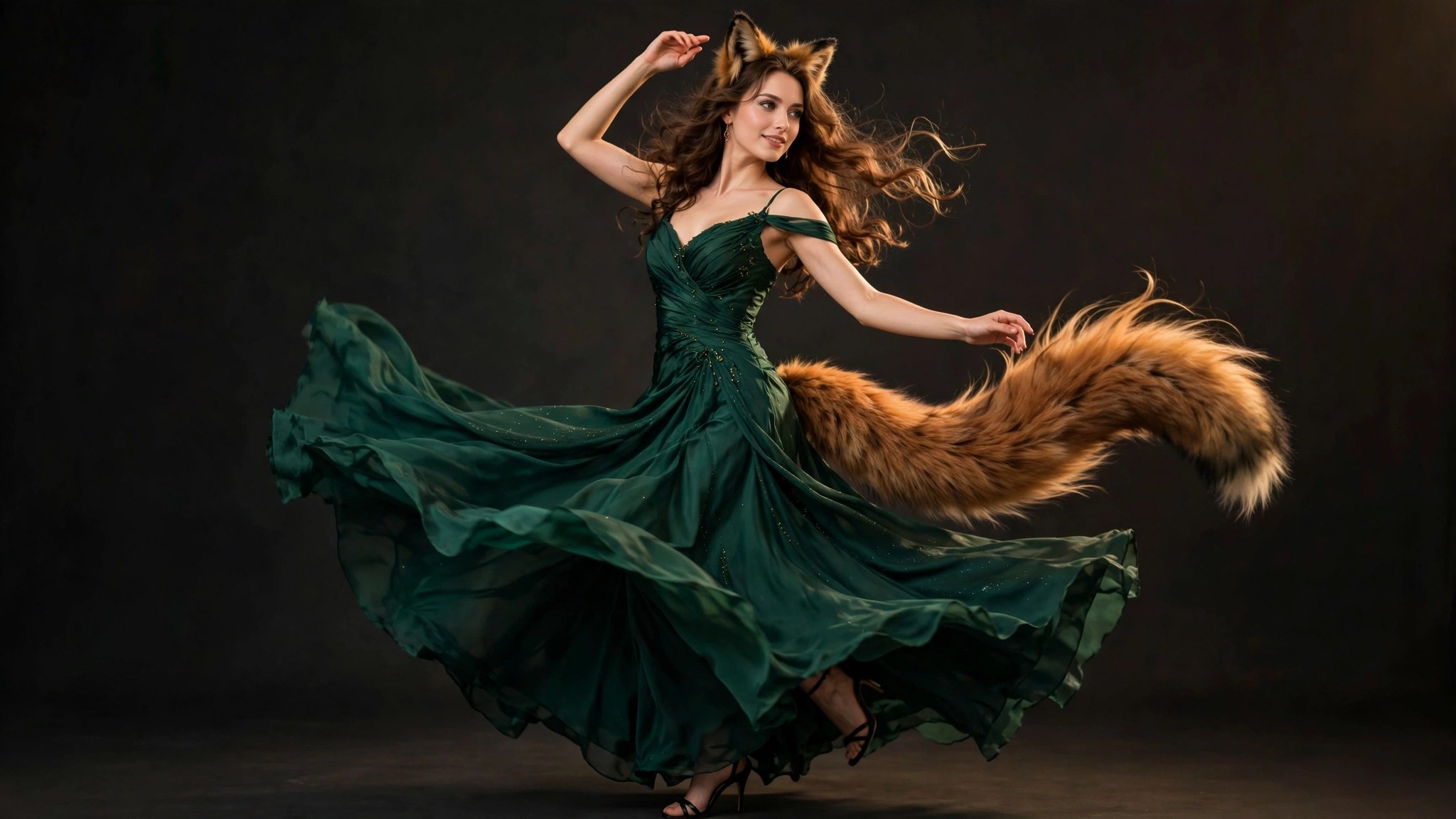
Write the tail into the pose prompt every time. “Tail swung out to the left as she turns right” is a sentence the model can use. “Tail visible” is not — the model will hang it straight down like a curtain. The three tail positions worth learning are the balance tail (out behind, following a turn), the rest tail (curled around the paws or lying along the ground), and the alert tail (raised, stiff, or bristled). Velge en, say it, and the rest of the body falls into place.
The tail also sets the silhouette. A character with a full tail has a shape that reads from across the room; without the tail, the silhouette is human. A character whose tail is always in a different place is a character whose silhouette keeps changing, and the set stops looking like one character. Keep the tail’s size and length consistent, and let it move.
3. Ears are body language too
Ears are the face’s second language. A fox with both ears forward is interested; one ear forward and one back is listening to two things at once; ears flattened back is fear or anger; ears swivelled sideways is confusion. The same face reads four different ways depending on the ears, and the model will give you symmetrical upright ears every time unless you say otherwise.
Write the ears as a pair, not a single state. “Left ear forward, right ear turned back” is a character hearing something behind her. “Ears flattened against the skull” is a character who has just been caught. “One ear up, one ear drooping” is a character who is tired or unsure. The asymmetry is the point: symmetrical ears are a statue; asymmetrical ears are a living animal.
Ears also move before the body does. A character that hears a sound turns an ear first, then the head, then the shoulders. Put the ears half a beat ahead of the body: the ear has already reacted, and the body is catching up.
4. Paws, claws, and weight
Paws are where most furry poses quietly fall apart. Human hands and feet have five separate fingers and a flat sole; paws have pads, claws, and a different weight distribution. A character standing on human feet with a fox tail is a person in a costume. A character standing on paws — weight on the pads, toes slightly spread, claws out or tucked — is an animal.
Claws are a choice, not a default. Claws out means the character is gripping, climbing, or ready; claws tucked means the character is relaxed or handling something delicate. Say which one: “claws out, gripping the branch” Eller “claws tucked, paws folded.” If you say nothing, the model picks at random, and you get claws where the character is supposed to be gentle — or no claws where she is supposed to be climbing.
Weight on the paws is the physics check. A crouching animal has weight on the back paws; a walking animal shifts weight paw to paw; a sitting animal has weight on the haunches. The prompt sentence is simple: “weight low on the back paws, front paws light.” Without it, the model draws all four limbs evenly loaded, and the character floats.
5. The crouch, the pounce, the stretch
Three movements carry almost every furry scene: the crouch, the pounce, and the stretch. The crouch is weight low, spine curved, tail out behind for balance, ears forward, eyes on the target. The pounce is the crouch released: body extended, front paws reaching, back paws pushing, tail streaming behind. The stretch is the opposite of both: spine arched, paws reaching forward, tail curled, the whole body long and loose.
Do not write the movement and the emotion in the same breath. “Crouching, frightened” makes the model pick one and drop the other, usually the pose. Write the movement first, then the emotion as a separate clause: “crouched low, tail out, ears forward, eyes wide.” The body does the emotion; the adjectives do not need to. A crouch with wide eyes is frightened. A crouch with a slow tail is hunting.
Practice with one species before you try them all. A fox crouch is not a wolf crouch: the fox is low and compact, the wolf is long and forward, the cat is coiled and springy. Pick your character’s species, learn its three movements, and reuse them.
6. En karakter, three movements
The test of a character is whether she is recognisable in three different movements. Take your character — the fox from the earlier articles, say — and generate her three times: once crouched, once stretching, once mid-turn. If she is the same character in all three, you have a character. If the ears, hale, or markings change, you have three different characters, and the set will not hold together.
The fix is a movement sheet: one sentence per movement, with the body details repeated verbatim. “Crouched low, spine curved, tail out behind, left ear forward, right ear back, weight on the back paws.” “Stretching, spine arched, front paws reaching, tail curled, ears relaxed.” “Mid-turn, body twisting right, tail swinging left, hair and gown mid-swing.” The repeated details are the character; the changed details are the movement. Copy the sheet into every prompt, change only the movement clause, and the character survives.
Sets are where movement pays off. A set of three images — crouch, turn, stretch — tells a small story, and a story is more shareable than a single portrait. Tre bilder på 6 credits each is 18 credits, om $0.36 på den $19.99 pack and about $0.22 på den $59.99 pakke. Generate the crouch first, check it, and lock what worked before you generate the stretch. The sheet is built from what worked, not from what you hoped would work.
7. The movement checklist before you generate
Before you spend a credit, run the checklist. One, the spine: can you say where it is — curved, straight, arched? Two, the weight: can you say where it sits? Three, den hale: can you say where it goes and what it is doing? Four, den ører: are they doing something, or are they symmetrical and still? Five, den poter: claws out or in, weight on the pads or flat? If you cannot answer one of those, the prompt is not ready.
Six, the species check: does the pose belong to this animal? A fox does not stand like a wolf, a cat does not crouch like a dog, and a rabbit does not pounce like a fox. If the pose could be any species, it is a human pose with ears. Seven, the outfit check: does the outfit allow the movement? A crouch in a jacket with no tail opening is a jacket that eats the tail. Eight, the story check: does the pose say something, or is it a pose for the sake of a pose? A pose with a direction — looking, listening, reaching — is a scene. A pose without one is a mannequin.
Kostnad: a moving character costs the same as a still one
Movement costs nothing extra. A standard image is 6 credits whether the character is standing still or mid-pounce. On the $19.99 pack for 1,000 credits, one credit is about $0.02, so one standard image is about $0.12. On the $59.99 pack for 5,000 credits, one credit is about $0.012, so one standard image is about $0.07. A movement sheet of three images is 18 credits: om $0.36 on the smaller pack, om $0.22 on the larger one.
Where the money goes is the re-rolls. A vague pose prompt — “a fox woman, dynamic” — can take five or six tries to land, and six tries is 36 credits, om $0.72 på den $19.99 pakke. A precise pose sentence — spine, vekt, hale, ører, paws — usually lands in one or two. Den $19.99 Og $59.99 packs are one-time purchases with credits added at once, and the annual packs of $119.88 Og $359.88 are paid once and release credits monthly across twelve months. Priser sjekket 13 nov. 2026.
The generator on this site is free to use with no signup required, so the movement sheet can be rehearsed on the free tier before any credits are spent. Free first, paid second is the cheapest order there is.
8. Samtykke: den regel det bestemmer alt
Bare generere bilder av deg selv, or of fictional adult characters. Never generate an image of a real person without their consent, and never generate an image that pretends a real person did something they did not do. The furry characters in this article are fictional adults, designed from scratch, and the rule applies to them exactly as it applies to everything else: if the character were a real person, the image would need their permission. It is not, and that is why it is allowed — and the line stays exactly there.
Consent is also a practical rule. A character built from a real person’s photo without permission is a character you cannot share, cannot sell, and cannot defend. A character built from scratch is yours. The pose is the character, and the character is yours because you made her, not because you took her.
Endelig dom
The pose is the character: start from the animal’s spine, not a human stance, and let the tail, ører, and paws follow it. A movement sheet — one sentence per pose, repeated verbatim — keeps the same character recognizable across a crouch, a turn, and a stretch.
The method costs nothing extra; the savings come from precise prompts that land in one or two tries instead of five or six. It only works for fictional adult characters, built from scratch — never for a real person without consent.
FAQ
What is the single most important thing in a furry pose?
The spine. A curved spine reads as an animal moving; a straight spine reads as a human standing still. Set the spine first, then let the tail, ører, and paws follow it.
How do I write a tail into a prompt?
Say where it goes and what it is doing: tail swung out behind for balance, curled around the paws, or raised and stiff. “Tail visible” is not enough — the model will hang it straight down.
Why do my furry characters look like people in costumes?
Because the pose is human. Straight spine, flat feet, symmetrical ears, hidden tail. Change the spine and the weight, give the tail a job and the ears an asymmetry, and the costume becomes a creature.
Can one character keep the same tail across a set?
Ja, if you repeat the tail’s size and length in every prompt and keep the movement sheet. The tail is the character’s silhouette; change the tail and you change the character.
Should I use motion blur for moving poses?
Usually no. Write the pose for movement — extended limbs, streaming tail, hair mid-swing — and keep the image sharp. A sharp image of a moving body reads as fast; a blurry image reads as a mistake.
Kan jeg lage AI-porno av en virkelig person?
Nei. Bare generere bilder av deg selv, eller av fiktiv voksne. Det er ikke tillatt å generere et bilde av en ekte person uten samtykke.